
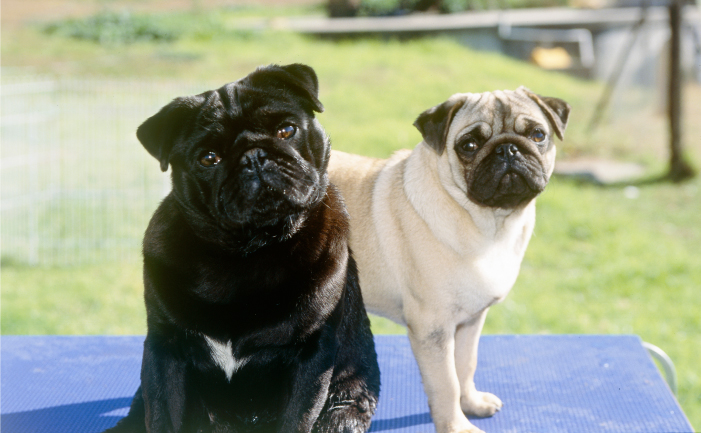
 Black & White Pugs |
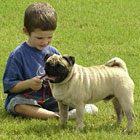 Pug Dog with Child Pug Dog with Child |
The Pug
Breed: Pug
Temperament: playful, exuberant
Maintenance: low-medium
Lifespan: 10-12 years
Recommended for: children to the elderly
History
Originally bred in China, over a thousand years ago, the Pug was brought to Europe by the Dutch East India Company. In Europe they became the dog of aristocrats and royalty holding high status amongst dog breeds. The pug became the official dog of the House of Orange, Holland, as recognition for saving the life of William, Prince of Orange, in 1572. The Pug was also reportedly a favourite in France during Napoleonic times. Napoleon’s wife Josephine apparently had great affection for the breed and it is alleged her dog, Fortune, bit Napoleon as he climbed into bed on the couple’s wedding night. Pugs are one of the earliest pure breeds of dog kept in Australia. Although it is uncertain as to when they arrived in this country, there are records from the Agricultural Society of NSW listing two pugs exhibited in 1870.
Appearance
The Pug has been described as “a lot of dog in a small space”. It looks like a miniature mastiff with a compact, square, cobby body, large bone structure and thick, wrinkly skin. The head of the Pug is short, blunt and large compared to the rest of the body. For many people the two most engaging characteristics of a pug are its face and tightly curled tail. Large dark eyes protrude prominently from the wrinkled squashed face and give the dog an animated expression. The tail is curled as tightly as possible over the hip, with a double curl being considered perfection. The coat is dense, soft, short and glossy. Pugs come in silver, black, and apricot/fawn with black mask and markings.
Temperament
Pugs are exuberant, alert and show great affection for their owners and everyone else. They are good with children and have a great attitude towards almost everything. In Holland the Pug is known as “Mopshond”, from the dutch word “to grumble”, which probably describes the snuffling and “talking” which is characteristic of the Pug. It certainly does not describe the nature of this little dog. Pugs will need to be kept in an enclosed area as their road sense is poor. However, a few pugs have been known to achieve their obedience titles.
Health and lifespan
Due to the their flat face the pug should not be over exercised or become overheated. They can experience breathing difficulties and need plenty of water and shade in hot conditions. Being prone to breathing problems means that pugs should not be allowed to become overweight. Excess fat around the heart can bring about premature death. The Pug’s protruding eyes are also prone to problems and should be kept clean and moist. Beware of rose bushes, cats and puppies playing. Eyes have been known to “pop out” of the dog’s head due to serious trauma although there have been some reports that minor stresses like sneezing or coughing can also cause this injury. The wrinkles of the dog should be monitored for skin problems and the fold across the nose should be wiped daily with lanolin or vaseline on cotton wool. Pugs will live for around 10-12 years. There is little information regarding genetic problems for Pugs in Australia. Much information exists in the US but no-one know how accurate this is for breeding lines in Australia. The Pug Club of South Australia has started work to evaluate these issues in conjunction with the South Australian Canine Association.
Care and Maintenance
Pugs have a fine short coat which is easy to keep in good condition. Breeders recommend grooming up to 10 minutes a day, firstly with a fine steel comb and then with a good bristle brush. Although ungroomed pugs suffer no problems due to lack of grooming. They do shed and drop a coat twice a year. Watch for overeating in the breed. Provided the dog is active around the home, little exercise is needed.
Breeding
It is recommended that only experienced breeders should breed Pugs. The dogs can experience many difficulties during birth. It is common for pugs to require veterinary assistance to deliver puppies (i.e. via caesarean section), however, good breeders should produce dogs with the ability to have natural births.
Recommended for:
Pugs are ideal for families with children and also make excellent companions for the elderly. The shape of the mouth prevents them from biting efficiently and this makes them reasonably harmless. Pugs are renowned for their friendly playful temperament, however, they are quite fragile, especially as puppies and should be looked after and supervised when playing. Pugs do enjoy the company of other pets and breeders advise that two pugs, a de-sexed male and a de-sexed female, are a great combination.
National contacts
To find up-to-date contacts for breeders, contact the following organisations.
Dogs NSW
http://www.dogsnsw.org.au/breeders-directory
Email: [email protected]
Phone: 1300 728 022 (NSW only) or (02) 9834 3022
Fax: (02) 9834 3872
Dogs Victoria
http://www.vca.org.au
Email: [email protected]
Phone: (03) 9788 2500
Fax: (03) 9788 2599
Dogs ACT
http://www.actca.asn.au
Email: [email protected]
Phone: (02) 6241 4404 – Fax: (02) 6241 1129.
Dogs West
http://www.cawa.asn.au
Email: [email protected]
Phone: (08) 9455 1188
Fax: (08) 9455 1190
Dogs SA
http://dogssa.com.au
Phone: (08) 8349 4797
Canine Control Council of Queensland
http://www.cccq.org.au
Email: [email protected]
Phone: (07) 3252 2661
Fax: (07) 3252 3864
Tasmanian Canine Association
http://www.tasdogs.com
Email: [email protected]
Phone: (03) 6272 9443
Fax: (03) 6273 0844
Dogs NT
http://www.territorydogworld.com
Email: [email protected]
Phone: (08) 8984 3570
Fax: (08) 8984 3409