
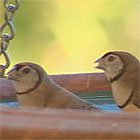
Recent research in the United Kingdom, United States of America and Australia shows that gardens are critically important for the survival of native species of birds. Don pointed out that only about 6% of Australia is in national parks, most of the rest is in private property. So anyone who owns land of any size has a responsibility to help preserve our native species. Feeding helps populations of birds survive, particularly in winter when there is not much food available. Without feeding, seed eating birds would simply disappear from most areas of Australia.
Making a bird feeder
Don showed how to make a bird feeder designed to hang under the eave of a house.
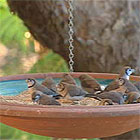
1. Find a suitable dish. Heavier dishes such as terracotta are better than plastic, because they are more stable in the wind and when birds perch on them. A large diameter, around 400-450mm, provides more stability – the attached chains will be a greater distance from each other and it will also allow a greater number of birds to perch at a time. This is particularly good for small species such as finches, which prefer to feed in groups. Don’t use a dish that is too deep. Birds prefer to perch on the edges, and this will also help to prevent seed from being fouled. A thin edge to the dish is also preferred as this allows the birds to perch securely. Square and triangular dishes are also available. Square dishes require four attachments, while smaller, triangular dishes require three attachments.
2. Once you have chosen a dish, measure and mark three spots equidistant around the circumference of the lip. Don did this by laying some string around the dish to give him the circumference. He then transferred the length to the tape measure and divided that into three.
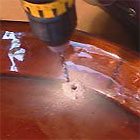
3. Using a masonry bit, drill three holes at each of your marks. (Tip: do not set the drill on hammer, or you’ll break the dish.) An optional step is to drill a drainage hole at the lowest point in the bottom of the dish.
4. Decide on the height of the dish and measure and cut three equal lengths of chain. (Tip: when calculating the length of chain, don’t forget to account for the drop of the hook.)
5. Open and slide a split pin onto the end of each length of chain. Now push a split pin through each hole from the inside of the dish to the outside. Bend the arms of each pin at right angles so they form a lock around the hole and prevent the chain from slipping away.
6. Decide where to hang your bird feeder. Choose a spot under the eave of the house or another suitably sheltered and protected area. Look for somewhere that is not accessible for cats. Fix the ceiling hook to the eave and hang the dish.
7. Keep the seed in the bird feeder fresh – wet or stale seed can poison birds so it should be changed daily. Avoid using seed mixes containing safflower or sunflower seeds. These attract cockatoos, which can do a lot of damage to structures and large trees.
Approximate costs
Dish:
A 400-500mm glazed dish, $20 – $30 at garden centres and nurseries.
Hardware:
2.6mm jack chain, $3.50 per metre
Zinc ceiling hooks, $2 each
Brass ceiling hooks, $4 each
Split pins, $4 each
A pre-made plastic bird feeder is much cheaper, starting from around $15. However these will break down over time and aren’t very durable. If you make your own feeder, you can pick a design and colour to suit your house and it will last much longer.