
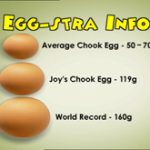
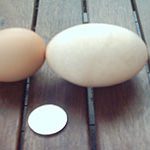
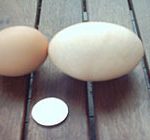
Joy Marshall from York, Western Australia, wrote to say that one of her chooks laid an egg weighing 119 grams. Joy wanted to know if there have been other eggs this size, or larger.
Last year a hen in Belarus apparently laid an egg weighing in at 160g (a typical egg weighs between 50-70g). The previous record egg weighed 146g, and was laid by a Cuban hen.
Don said that Joy’s chook would almost certainly be an ISA Brown. The ISA Brown is of French origin, and is a cross between a Rhode Island Red and Rhode Island White. A characteristic of the ISA Brown is that it tends to produce large, double-yolked eggs, becoming larger during each laying season. It is highly unusual for a double yolker to hatch, although there are records of them hatching and producing twins.
Big chilli
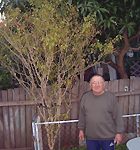
Alfredo Aldini, from Bronte in New South Wales, wrote to tell Don that he has a chilli ‘tree’ 2.5m in height. Don was very impressed by the photo of Alfredo standing beside the huge chilli plant.
Don explained that in cool zones, chillis grow for about a year and then die down over winter. However, the further north you go, the warmer the climate and the longer chillis survive. In warm zones or even in a protected zone in many areas of Australia, chillis will keep on growing!
If your chilli is bigger than 2.5m, please let us know. But for the moment, Alfredo Aldini holds the unofficial record.
Grass tree
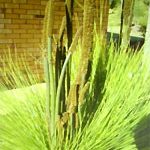
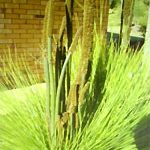
Helen Simeoni, from Caniaba Via Lismore, emailed to say that her grass tree has approximately 23 spears on one head. Helen asked if this is unusual. Don said that it was common for grass trees in Western Australia to produce large numbers of spears, but he’d never seen one on the east coast with so many. Well done Helen!
Grass trees (Xanthorrhoea australis) are evergreen, grass-like Australian native plants. They are related to lilies but have been placed in a separate family, Xanthorrhoeaceae. They are long lived and they grow very slowly. Young plants appear as grassy tufts, and years pass before they form trunks. They produce spear-like flower spikes, which tower several metres above the plant. The trunks of old grass trees are often blackened by many bushfires.
Peppercorn tree
Margaret Wade of Berridale in New South Wales emailed regarding her peppercorn tree. Margaret has heard that you need two trees to produce peppercorns. She asks if it is possible to buy male or female plants.
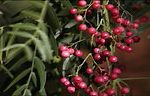
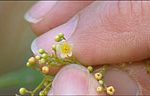
Don said that yes, peppercorn trees (Schinus areira) do occur as separate male and female plants. These beautiful trees are native to the slopes of the Peruvian Andes. They have dark green, compound leaves, which are aromatic when crushed. Old specimens have massive, gnarled trunks. Peppercorns produce clusters of small, creamy-white flowers, followed (on female trees only) by chains of coral-red berries.
Don said that to the best of his knowledge, you can’t buy labelled boy or girl plants. However there’s no need to worry, because in most areas of Australia there will be a plant of the opposite sex nearby and Mother Nature will take care of the rest. Margaret if your peppercorn tree does not produce fruit, it’s a boy.
Letter of the Week
This week’s award goes to Helen Simeoni, from Caniaba Via Lismore, for telling us about her fabulous grass tree. Congratulations Helen, you will receive a year’s free subscription to the Burke’s Backyard Magazine.