
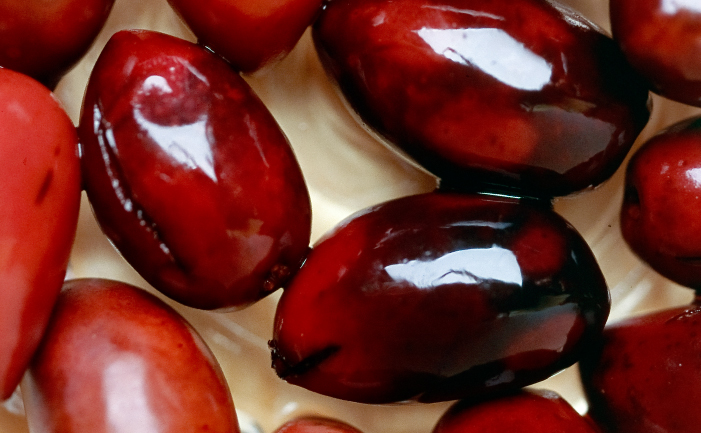
You’ll need:
- fresh black or green olives
- salt
- water
- sterilised glass jars with lids*
1. First, wash and prepare the olives. Discard any with blemishes, separate the green and black ones if necessary (they have different soaking times, so need to be soaked separately). Now, use a sharp knife to make two lengthways cuts into each olive, down to the stone (one cut on either side of each olive).
2. Put the prepared olives into sterilised jars*. I use the preserving jars with a rubber ring and a clip on top, but any clean, sterilised jar with a lid will do. Add the olives until the jar is just two-thirds full. Then cover the olives with water (ordinary tap water). Now, here’s a handy trick: part-fill a small plastic bag with water, tie it at the top, sit it on the olives in the jar. This keeps the olives underwater. Seal the jar with the lid.
3. Change the water every day. Pour out the old water, pour in fresh tap water. For black olives, do this for 4 days. For green olives, do it for 6 days. Don’t worry if, when you open the jar each day, you see a scum forming on top of the water. That’s normal.
4. After the 4 days of soaking for the black olives (or 6 for the green), fill the jars with a brine solution (brine is salty water). To make brine, mix in 1/3 cup salt to every 1 litre of water you need. Heat up the salty water in a saucepan, and stir until all the salt has dissolved. Let the water cool for an hour or two. Then pour it over the olives, to fully cover them.
5. Then pour some olive oil over the top of the brine solution, to completely cover the olives. Seal the jars, then leave them for 5 weeks. After that, your olives are ready to eat. You can keep your olives stored for up to 6 months in a cool, dark, cupboard. You can leave them stored in the brine. But I lash out on a big 4-litre tin of olive oil, and store my olives in olive oil.
* Tip: to sterilise jars, wash them well first, then place the whole jar (and the lid) into a large pot filled with boiling water. Immerse the whole jar in water. Let the water simmer away for several minutes, lift the jars out carefully, let them dry on clean paper towels. Do this sterilising while you make the cuts in all the olives, in step 1.