
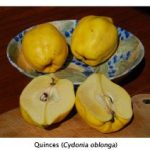
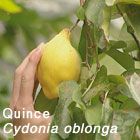
Quinces
The quince (Cydonia oblonga) is an excellent backyard fruit tree for cooler parts of Australia. No wonder it is becoming trendy again, because it has several things going for it: it’s small (around 4-5m, but they can be kept smaller with pruning), it puts on a good spring display of white flowers, a nice autumn show of colour as the leaves fall, and, best of all, a great crop of golden-yellow fruit in autumn and early winter.
The fruit cannot be eaten raw – they are usually too sour and astringent for that – but they do make wonderful jams, jellies and pastes, and when poached or baked with sugar and cinnamon they make an excellent dessert or, our favourite, a breakfast treat.
Growing tips: winter (June, July, August) is the ideal time to plant a bare-rooted quince tree. The good news is that quinces aren’t a fussy fruit tree to grow. They tolerate a variety of soil types and even a variety of climate zones much warmer than those where you can grow apples, for example (they’re worth a try in Sydney) , but they do perform better in cooler areas which always get cold winters.
Plant quinces in a sunny spot that gets some protection from strong winds (to prevent bruising of the large fruit). When the fruit are forming on trees, try to give the plants a steady supply of water, for better crop production. Quinces crop heavily, and sometimes a branch laden with lots of big fruit can break on windy days, so it’s a good idea to thin the number of fruit on each tree when they are forming. Left to grow naturally, quinces are multi-stemmed, but you can cut off the lower branches to create a single trunk. You can also prune them to keep them more compact, and they won’t complain. However, if you neglect your quince tree, they won’t mind much, either. They really are an easy-going fruit tree for backyards.
Quince Jelly
quinces
1 lemon to every 3 quinces
caster sugar equal to liquid, when measured (see step 3)
1. Wash the quinces thoroughly to get rid of the downy ‘bloom’ on the skin, then peel and cut the flesh into chunks. Keep the peel, seeds and cores and put these into a muslin bag (or use a clean, new Chux super-wipe to make a bag). Finely peel the lemon, then squeeze the juice. Put the quinces, lemon peel, lemon juice and the muslin bag into a wide saucepan with just enough water to cover the fruit. Put a lid on the saucepan, bring to a simmer and cook for 60-75 minutes. Keep on cooking gently until the quinces turn a rosy-red colour.
2. Strain the liquid and discard the pulp and peel, but do it slowly and carefully. Line a colander with muslin (or another clean, new Chux) and set it over a bowl (ceramic or glass). Pour the liquid and pulp in and leave it there overnight. Don’t press down on the mixture to squeeze extra liquid out, or your jelly will become cloudy. Let gravity do the work for you.
3. The next day, measure the juice, add the sugar (ie, for 500mL of liquid, add 500g sugar). Return the liquid to the pan and bring to the boil, stirring once or twice to dissolve the sugar. Finish the cooking very rapidly and without a lid on the pan. If any scum rises to the surface, skim it off and discard.
4. To test that it the jelly is set, have a plate chilling in the fridge. Dollop a teaspoon of liquid onto the plate and put it in the fridge for a minute. If you then push the dollop with your finger and it ‘wrinkles’, it has reached setting point and is ready. Bottle into hot, sterilised jars.
Good uses for quince jelly
1. Spread it on toast for breakfast
2. Spread it on crackers, top with cheese
3. Stir it into gravies for roasted pork or quail
4. Stir it into mascarpone or cream to dollop onto desserts
Breakfast quinces
Quinces are delicious poached or baked, then served with your favourite cereal, or natural yoghurt, for breakfast.
To poach them, peel, core and cut into chunks. Simmer gently in just enough water to cover them, adding a tablespoon of caster sugar per quince, plus a cinnamon stick. Poach for about 60-80 minutes until the quinces are tender and red-coloured (about 60-80 minutes).
To bake them: peel, core and cut into chunks, put into a lidded casserole dish along with a tablespoon sugar per quince, plus a whole cinnamon stick. Bake for 2-3 hours at low temperature, 120-140°C, until tender and red-coloured.