
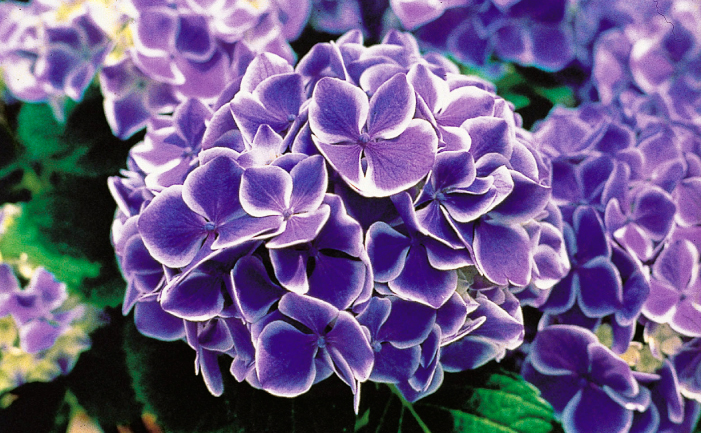
Mai-Ko Hydrangeas
Hydrangeas were discovered in Japanese forests by early European explorers, who took plants back to Europe and used them to develop the hydrangeas we know and love today.
Japanese grower/breeder Hiroshi Ebihara decided to import ‘European’ hydrangeas back to Japan in 1970. His breeding program resulted in the production of compact hydrangeas with large, multi-coloured flowers. In Australia they are known as the ‘Mai-Ko’ series of hydrangeas.
Mai-Ko hydrangeas have a dense growth habit and develop into strong, bushy shrubs. They can be grown in the garden or in large pots, and the flowers can be used fresh or dried for floral arrangements. These hydrangeas have a long flowering period – from spring to autumn. They like a semi-shaded position, with protection from wind and hot afternoon sun. Pruning is simple – remove spent flowers and shape the plant during summer. Mai-Ko hydrangeas are sensitive to soil pH and change colour easily (see below).
Mai-Ko varieties
Mai-Ko hydrangeas come in a range of intense colours including pink, blue, purple and violet, all with white margins on the petals.
There are six varieties:
‘Mariko’ – blue and white
‘Taiko’ – violet blue and white
‘Nobuko’ – purple and white
‘Machiko’ – pink and white
‘Sumiko’ – white and pink
‘Reiko’ – pink with a white lace-cap
Changing the flower colour
Hydrangeas are very versatile in that you can actually alter the flower colours to suit your needs. The flower colour in most forms relates to the acidity or alkalinity of the soil. In acid soil (pH 5 or less) hydrangeas are usually always blue. As the soil pH climbs towards the neutral and alkaline end of the scale (pH 7 or more) hydrangeas turn mauve, pink and red. A blueing tonic (containing aluminium and iron) will turn pink or mauve hydrangeas blue. It should be applied every 2-3 weeks from late autumn to early spring, following the directions on the pack. A cup of lime (calcium carbonate) added to the soil in spring will cause blue or mauve hydrangeas to turn pink. White flowering hydrangeas will remain white regardless of soil pH.
Further information
Mai-Ko hydrangeas are available from nurseries and garden centres Australia-wide. Approximate cost: 140mm (6″) pot $12, 200mm (8″) pot $20-$25, 250mm (10″) pot $30-35.
Yates Hydrangea Blue Tonic costs around $6 a pack.