
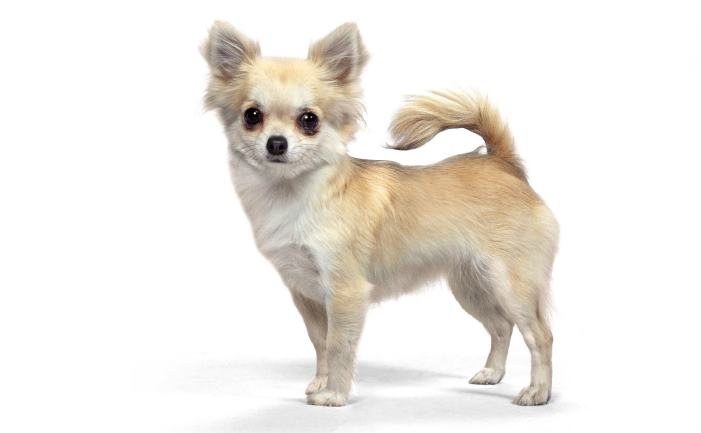
Chihuahuas
BREED: Chihuahua
TEMPERAMENT: Timid but can be snappy
COST: $300+
LIFESPAN: 10-14 years
RECOMMENDED FOR: Older people
DUMPAGE RATE: Medium
MAINTENANCE: Low
The Chihuahua is a breed which is not recommended for families with young children but is ideally suited to older people, possibly those whose families have ‘left the nest’. The breed’s popularity has declined in recent years.
Appearance
The Chihuahua is a lightly-built dog, tiny and fragile with a large rounded skull and big dark eyes. There are two types, the smooth-coated and long-coated. They are usually less than 20cm (8″) tall and weigh between 0.9-1.8kg (2-4lb).
There are two forms: the smooth-coated which has a soft, short, close coat; and the long-coated which has a long, soft, flat or slightly curly coat with fringed ears, feathered feet and legs and a ruffle around the neck. Coat colours range from white through cream, sable, sand, blue to black.
Temperament & training
Owners describe their dogs as feisty, saucy, cunning, clever and protective. They can become very attached to their owners and reserved around strangers, and especially around children if not used to them.
While owners say Chihuahuas are trainable it does take some time compared with other breeds. Some owners report difficulties in house-training males.
Health & lifespan
While not as fragile as their appearance may suggest, it would be wise to deal with reputable breeders as Chihuahuas have potential problems, some hereditary: Slipping patellas, a condition where the kneecap moves and causes a swivelling action in the legs as the dog moves, are found in this breed. This is an inherited condition and good breeders do not breed from affected dogs.
The prominent eyes can also be vulnerable to injury or infection.
Heart murmurs are often detected in older dogs but treatment is not always appropriate.
Teeth are prone to a build up of tartar. This can be minimised by feeding chicken bones but severe cases may require anaesthetic to be treated properly.
The dog’s domed head has a soft spot, called a molera, which may not close over and needs to be handled with care. Most Chihuahuas live 12-14 years.
Ideal owner
Chihuahuas are not recommended for families with small children as they are too easy to pick up and consequently, easily injured if dropped. Long time breeders and owners feel they are best suited to homes with older adults and may be great companions for people with limited budgets and limited space.
Housepet potential, space & exercise
Chihuahuas really need to live indoors and their diminutive size means their space and exercise needs are accommodated inside the home. However, they are active little dogs that enjoy a walk.
Uses
While primarily a companion dog, some owners call the Chihuahua a ‘pocket watchdog’ which can be noisy if visitors arrive. Many older people enjoy and encourage this early warning system.
Breeding
This is not a breed for the novice as problems with whelping and caesareans are common. Litters usually consist of one to three pups.
Grooming
Chihuahua toenails grow quickly and if not clipped regularly can cause the dogs to slip on hard surfaces. They are low maintenance with a weekly brush being the main requirement.
History
Named after the state of Chihuahua in Mexico these dogs are claimed to have performed many functions from spirit guide to food source. It’s said there once were Mexican dog markets where desexed Chihuahuas were sold by the bundle to be sacrificed or eaten at feasts. The long coated variety is a recent development in Chihuahuas. They have been bred using Papillons and probably other small, fluffy breeds. Today they are one of the world’s most popular toy breeds.
National contacts
To find up-to-date contacts for breeders, contact the following organisations.
The Australian National Kennel Council (ANKC)
www.ankc.org.au
Dogs NSW
http://www.dogsnsw.org.au/breeders-directory
Email: [email protected]
Phone: 1300 728 022 (NSW only) or (02) 9834 3022
Fax: (02) 9834 3872
Dogs Victoria
http://www.vca.org.au
Email: [email protected]
Phone: (03) 9788 2500
Fax: (03) 9788 2599
Dogs ACT
http://www.actca.asn.au
Email: [email protected]
Dogs West
http://www.cawa.asn.au
Email: [email protected]
Phone: (08) 9455 1188
Fax: (08) 9455 1190
Dogs SA
http://dogssa.com.au
Phone: (08) 8349 4797
Canine Control Council of Queensland
http://www.cccq.org.au
Email: [email protected]
Phone: (07) 3252 2661
Fax: (07) 3252 3864
Tasmanian Canine Association
http://www.tasdogs.com
Email: [email protected]
Phone: (03) 6272 9443
Fax: (03) 6273 0844
Dogs NT
http://www.territorydogworld.com
Email: [email protected]
Phone: (08) 8984 3570
Fax: (08) 8984 3409