
With more than 300,000 exhibition budgerigars bred in Australia annually it’s the world’s most competitive animal. But what of its wild cousin – the bird which began it all?
Appearance
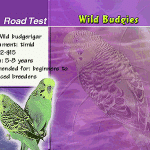
Wild budgerigars are quite small, slim, athletic birds when compared to pet or show birds; exhibition budgies may be four times heavier than wild specimens! And while there are potentially more than 20 million different colour combinations in the modern exhibition budgerigar, wild budgies are green. Any significant variation on this would make the bird stand out from the crowd, and therefore, an easy target for predators like hawks.
When wild birds fly they are pretty much like swallows or swifts – absolute acrobats of the air. Their athleticism also means they can be difficult to catch in an aviary.
Temperament
As a rule, budgies are outgoing, bright birds, which can become affectionate toward their owners. Most are gregarious although individuals can become aggressive if nesting. Wild budgies are much more timid than domesticated ones.
Health
Wild budgies do not have the resistance to disease in captivity that domesticated ones do and may not be as robust in captivity.
Feeding
A breeder we spoke with feeds his birds a mix of French millet, canary and sunflower seeds. Other suitable food includes Japanese millet. Cuttlefish is also important. Commercial mixes start from about $2 for a 1kg bag.
Breeding
Wild budgies are unlikely to breed in small cages or breeding cabinets as the exhibition budgies do. For successful breeding an aviary is required and during the breeding season each pair will need a breeding box or, ideally, a log in which to lay their eggs and raise their babies.
Most pairs can raise their own babies, usually four chicks. Normal breeding season is June to January.
Space & housing
Cages which are longer rather than taller are recommended for budgies. More birds may be kept in aviaries which need a weather-proof perching area at one end. Aviaries may also be landscaped with native grasses. During breeding season each pair will need two breeding boxes or hollow logs.
For further information
It is illegal to take wild budgies from the wild in all states except SA where budgies are unprotected. For further information contact your State’s wildlife authority. We filmed our segment with breeder, Alan St. Clair, phone: (02) 6959 2189.