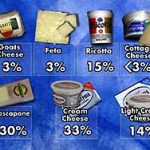
Cheese is a great source of calcium, but it’s also high in saturated fat. The amount of fat varies, and you can’t always guess which cheeses have the most. For example many people think brie is a fatty cheese, but with 28% fat on average it actually has less fat then standard cheddar with 36%. Double and triple cream cheeses are quoted as having about 60% fat, but this is based on calculations that ignore their high moisture content. If the calculations are done taking their moisture content into account they have approximately the same amount of fat as standard cheddar. Imported blue cheese can be high in fat at around 43%, while Australian blue has 36%, again much the same as standard cheddar.
Low fat cheese
There are plenty of low fat cheeses to choose from but read the labels carefully, paying attention to the fat and calcium contents. You also need to decide if you like the taste of reduced fat cheeses.
Cheddars – some have reduced their fat right down to 7%, and some have the bonus of added calcium.
Goat’s cheese and fetta – available with only 3% fat (most fetta has about 20% fat so check the label).
Ricotta – varies in fat content from 15% down to 5%.
Cottage cheese – generally less than 3% fat.
(Note: neither cottage cheese nor ricotta has as much calcium as yellow cheeses.)
Cream cheese – high in fats and low in calcium. For example mascarpone has 30% fat, ordinary cream cheese has 33% and the light cream cheese has 14%.
Guilt free cheese
It is possible to include cheese in a healthy diet as long as you don’t eat too much. French and Mediterranean diets contain lots of cheese but people in those countries have very low levels of heart disease. Follow their example and combine cheese with healthy foods, good bread, vegetables, salads and fruit, and you can enjoy it without feeling guilty.