
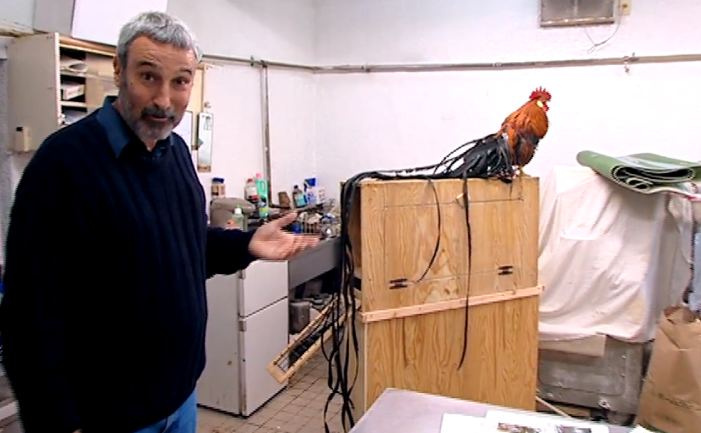
Japanese Long-tail Fowls
Don visited Mr Kazuo Miyashita, who is a shop owner dealing in rice and Japanese sweets. He is also a fowl hobbyist, and for the last 15 years has bred around 50 different kinds of chickens, including the rare Japanese Long-tail fowl (Onagadori).
Honourable fowl
Roughly translated, Onagadori means ‘Honourable Fowl’. This is one of the rarest breeds of chicken in the world. There are only a handful of breeders in Japan and there are only around 200 of these birds in existence.
The longtailed breeds emerged in South-East Asia, apparently arriving in Japan before the Edo period (1603-1867). They were then developed through selection and cross breeding to meet Japanese tastes. When Japan reopened to trade at the end of the Edo period, the unique longtailed breeds were exported to the West. Most were exported from the port of Yokohama and for a long time all longtailed breeds were simply known as ‘Yokohama’. The true, modern Onagadori as it is known today emerged in the 1920s and 30s.
Long-tail fowl are not bred in Australia, but in Europe and Germany they are crossed with other types of fowl to produce proto-onagadori and ‘Phoenix’ fowl.
Amazing tail
To be regarded as a Long-tail fowl, the bird’s tail must be at least 2m long. The world record in terms of length of tail is around 14m (45-50 feet). Good quality Long-tail roosters have tail feathers that grow at a very fast rate – approximately 1m per year. If kept in the best of conditions with high levels of animal husbandry, the tail feathers are non-moulting and grow for the life of the roosters. The hens moult normally, as do the feathers that cover the head, breast, back and legs.
Long-tails require individual stalls and tall roosts to prevent damage to the tail feathers. Litter must be constantly cleaned in the stalls, and there must be constant contact with the owners to facilitate handling. Often, the tails are gently coiled up and kept in a light cotton bag to protect the delicate feathers.
Long-tail fowl have a single comb, white earlobes and a red/brown eye colour. Cocks weigh around 1800g, with hens about 1350g. They come in red or white hackled, white or brown.
There is also a short-legged miniature variety of the Long-tail fowl. The tail on this miniature variety along grows about 1m long.