
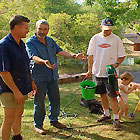


This week’s program was a Come & Save My Garden special. Don Burke and Scott Cam were on the road, knocking on doors and asking people if they needed any help with their gardens and homes. They pruned, nailed, planted and fertilised their way across the neighbourhood!
Daphne & Jeff’s citrus
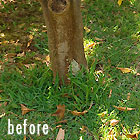
Daphne and Jeff Smith’s orange tree needed fertilising, mulching, watering and some general TLC.
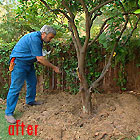
Don used a sharp spade to take the grass back about 1-1.5m from the trunk (Tip: you could also use a glyphosate-based product such as Zero or Roundup for this job, but be very careful not to let the herbicide touch any part of the tree). It is important to keep the area beneath citrus trees free of grass, because the grass competes with the tree for nutrients.
Don mulched the tree with a thick layer of stable manure, taking care not to let the manure touch the trunk (ring local stables for stable manure, which costs around $45 cubic metre).
A low-growing, dead branch at eye level was pruned off for safety.
Fruit & Citrus food (about $15 for 10kg) was applied according to the directions on the packet. Rose food is much the same as citrus food and would also be suitable.
Finally, the tree was watered well.
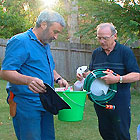
To help Daphne and Jeff look after their orange tree and garden, Don presented them with a hose, sprinklers, pH kit, hat, T-shirt and a copy of the Burke’s Backyard Magazine.
Neville & Ruth’s place
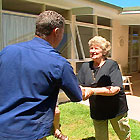
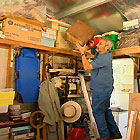
Neville and Ruth Fountain treated Don and Scott to a guided tour of their lovely home. The property was so well maintained that there were no problems for Don and Scott to fix. Ruth, who is a talented artist, was busy decorating diaries, coasters and soaps to give to friends as Christmas presents (see Ruth’s soap painting tips below). Neville even allowed Scott to take a peek into his shed. Scott thought the shed was well equipped, except that there was no beer fridge!
Ruth’s soap painting tips
1. Using a high gloss polyurethane paint (e.g. Estapol), paint a shape onto soap (any soap can be used).
2. Dab acrylic colour for base coat onto this shape.
3. Using acrylic paint and a paintbrush, outline the design and allow to dry.
4. Block in colours with acrylic paint.
5. When dry apply a thin coat of polyurethane over the design to seal.
6. The soap can be used and the design will stay.
These soaps are a lovely gift to give with a hand towel (visit a local craft store for more advice on soap painting).
Adam’s box elder
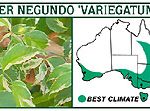
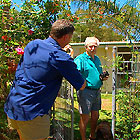
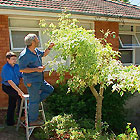
Don spotted a variegated box elder (Acer negundo ‘Variegatum’) in Adam Stefanowski’s front yard. There were a few problems with Adam’s tree: it was growing under the power lines and it was reverting to the green foliage of the species (Acer negundo). Don showed Adam and his son, Daniel, how to prune the tree to keep it away from the overhead wires. Also how to remove the vigorous green shoots and preserve the attractive, variegated foliage.
The box elder is a fast growing, deciduous tree from eastern North America. It can reach up to 20m (60′) tall, with a wide spreading crown. The compound leaves are made up of 3-7 leaflets, each with serrated or irregularly lobed margins. In autumn the foliage turns butter yellow, often with orange-red tones. This species sets seed freely and is an environmental weed. It should not be grown near bushland.
‘Variegatum’ is a pretty cultivar featuring marbled light green and creamy white leaves. It is not weedy and does not grow as tall as the species. However, it does have a tendency to revert to the green foliage of the species, so all shoots with green leaves should be removed.
Golden conifer
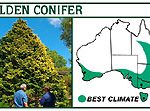
Don and Scott came across a golden conifer as they walked along the street. The conifer, (Chamaecyparis obtusa ‘Crippsii’), was gold on the sunny side, but greener on the shady side. Don explained that the sun bleaches the foliage tips of golden conifers.
‘Crippsii’ is one of the most popular golden conifers in Australian gardens. It grows into a broad, pyramid-shaped tree about 5m (15′) tall, and has foliage arranged in horizontal, flattened sprays. It grows best in well-drained soils in the cooler zones of Australia. Plant in an open, sunny position for best foliage colour.
Sean & Kristen’s Garden
Don and Scott asked Sean and Kris Baihn if they needed help with any gardening or building problems. Sean asked Scott to help build a timber retaining wall, while Kris asked Don for some advice on the design and selection of plants for the front yard.
Retaining wall
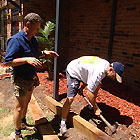
Sean was using sleepers to build a small retaining wall in front of a garden bed. Before starting work, Scott made sure that the sleepers were H4 treated pine. (Treated pine rated below H4 is not suitable for use in contact with the ground. It is important that cut ends are also treated with a timber preservative to protect them from rot or insect attack.) He also advised Sean to use galvanised nails rather than steel brights when nailing outside. Scott used his chain saw to cut the sleepers to size, and then helped Sean to level and position them.
Going troppo
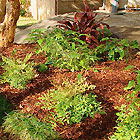
Sean and Kris decided they’d like a relaxed, tropical feel for the garden. Don suggested a range of suitable plants, including:
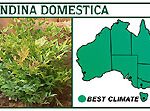
Japanese sacred bamboo (Nandina domestica ‘Gulf Stream’)
‘Gulf Stream’ is a dense, evergreen shrub about 50cm (20″) high and 50cm (20″) wide. It has graceful, bamboo-like foliage, colouring to beautiful orange and scarlet tones in the cooler months of the year. A 300mm (12″) pot costs approx. $50.
Xanadu (Philodendron ‘Xanadu’)
An evergreen, low shrub with a compact, tidy growth habit and attractive lobed leaves. It rarely exceeds 1m x 1m, and usually grows to around 75cm (2’6″) high. Xanadu gives an instant tropical look to a garden. A 200mm (8″) pot costs around $24
Bamboo palm (Chamaedorea seifrizii)
An attractive palm from Central America, with dark green leaves and pale bluish-green stems. It prefers a shady position in the garden, with plenty of water, particularly during dry spells. Expect to pay about $27 for a 200mm (8″) pot.
Sean was delighted when a trailer-load of plants arrived, as a gift from Burke’s Backyard to help get the garden started. Coincidentally, the selection included ‘Gulf Stream’, which Kris had only recently been admiring in the local nursery.
Soil preparation and planting
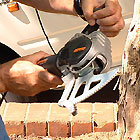
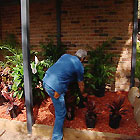
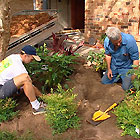
Sean and Don began work putting in the plants, but when Don started to dig the planting holes, he hit tree roots. He decided to cut through the roots using a special tool from Arbortech (see pic). (Arbortech Allsaw 150, $950 from hardware stores nationally, phone (08) 9249 1944.)
Don pointed out that the soil in the garden was water repellent (or hydrophobic), and the water was just running off instead of soaking into the soil. These soils can be treated with a soil wetting agent such as Wettasoil ($17 for 1 litre) or SaturAid ($10 for 500g). However, we’ve found on Burke’s Backyard that a thick mulch of stable manure is even more effective (about $45 per cubic metre from stables). As luck would have it, Don brought some stable manure with him, and also a load of ornamental pine bark to spread over the top of the manure (horticultural grade 10-15mm pine bark costs $50 cubic metre). He also gave Sean two sprinklers, and advised him to water the garden for about an hour once a week until the plants become established and the soil starts to accept water properly.