

Don visited a suburban back garden which was looking like a dust bowl disaster and was in need of a complete renovation. The main existing problems were:
retaining wall without drainage and weep holes which allowed the area behind to become waterlogged during wet weather
poorly built stone retaining wall which had been backfilled with concrete, the expansion of which had cracked the wall
pencil pines and an old conifer which had grown up into the native Angophoras and were looking unattractive
bare ground with old timber stepping rounds which was unsuitable as a children’s play area
landscaping that wasn’t pleasing to the eye
paved entrance path which required relaying
The owners wanted to create a low maintenance garden with a lush tropical look and to provide a lawn for family recreation. An important objective was to recycle any useful plants or materials on the site.
The garden was shaded for about half the day by surrounding trees so plantings had to be appropriate for the conditions. The garden was located in Sydney but the same tropical look could be achieved in Townsville or Tasmania given a careful choice of plants.
Preparation
Draw up a plan to scale to show all aspects of the proposed garden in relation to the house and boundaries (see Diagram 1).
Obtain Council approval to remove pencil pines and conifer. Approval was granted on the basis of the trees interfering with the native vegetation.
Before digging, locate all services such as phone, water, electricity and gas lines running underneath the garden
Stage 1- Demolition
The original retaining wall was demolished, carefully removing the stone and cleaning away any residual mortar from it. Stone was stockpiled for re-use later.
Break up and remove the concrete and clean away buried rubbish. A large natural rock shelf provided inspiration to incorporate a small fish pond in the garden.
Removal of trees by a professional arborist.
Chipping of trees and other unwanted shrubs and stockpiling mulch for re-use.
Grinding of the stumps to prevent regrowth.
Stage 2 – Reconstruction
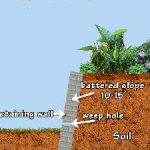
One of the original retaining walls had been built vertically (instead of sloping back at 10-15%) and was devoid of weep holes. In wet weather water ponded in places. For the correct design of a retaining wall see Diagram 2.
Hint:For a quick fix Don removed some soil behind the wall, drilled some weep holes into the mortar and backfilled with about 30cm (1′) of blue metal. Porous potting mix was placed on top of this.
Rebuilding of the retaining wall as a ‘dry packed’ bank
Hint: Because there would be young children playing in the garden it was important to use concealed mortar when laying the stone wall. The look was still ‘dry packed’ but the wall was quite secure.
Relaying of the path
By simply re-aligning the old pavers the path gained a sense of direction.
Hint:Whenever you lay a path always install a large pipe (we used 7.5cm (3″) PVC) under the path. This will be useful for directing power or irrigation pipes under the path without having to dig up the path at a later date.
Stage 3 -Planting
In the process of digging out old shrubs it became apparent that the soils were very shallow and impoverished. Areas to be planted were built up with Australian Native Landscape’s Garden Mix comprising 50% black soil, 20% coarse sand and 30% organic mix.
Redefining the curves in the garden edging.
Hint: Once the area is cleaned up it is important to reconsider the original plan. We used a garden hose to create the most aesthetically pleasing curve to the edge of the garden. A stone edge was constructed by reusing rocks from the site.
Designing the planting layout. Plants were chosen to provide contrasts in colour, texture and height and to be appropriate for the partly shaded conditions. The garden already had some interesting textures and colours. We retained a large clump of Bird-of-Paradise (Strelitzia reginae) a large Bird’s Nest fern (Asplenium australasicum), a grey-leafed Yucca (Yucca sp) and Grevillea arenaria with its soft grey foliage.
Hint: Before planting, lay all of the plants out in position in their pots. By regularly standing back you can make minor changes to get just the right look. When you plant make sure that the top level of the root ball is level with the soil surface.
After planting, we applied the recycled mulch at a depth of 7.5cm (3″). Be careful to keep the mulch away from the base of the plant or it will encourage collar rot.
Plant list
1. Overstorey plants included:
Bangalow palms (Archontophoenix cunninghamiana) provided the tall and tropical look to the garden in three focal spots. The plants purchased were multi-trunked and varied in height from 3.5m to 1.5m.
Soft Tree Ferns (Dicksonia antarctica)
A large clump of bird-of-paradise (Strelitzia reginae) was already in the garden and so was supplemented with some extra plants. The broad bluegrey leaves and striking orange and purple flowers created colour and textural contrast.
The broad-leaf Palm lily (Cordyline petiolaris) will grow to about 2-3m (6-9′) and in winter produces branched arching inflorescences bearing white to purplish flowers which are followed by red berries in summer
2. Understorey plants included:
advanced plants of Japanese Sacred Bamboo (Nandina domestica) were carrying their winter red berries adding a splash of red foliage colour and tying in with the red ribs on the bird-of-paradise leaves. These were underplanted with dwarf nandina (Nandina domestica ‘Nana’)
Oyster plant (Acanthus mollis) with its shiny, lobed dark green leaves
Philodendron ‘Xanadu’ is commonly used as both an indoor plant and for warm temperate or subtropical gardens in dappled sunshine. These were planted in a grouping on the highest terrace where their dense clusters of lobed leaves made a bold statement.
Clivia (Clivia miniata ) was planted among the Xanadu and in spring would provide a splash of orange. Clivia will grow in dappled shade through to deep shade.
Cast Iron Plant (Aspidistra elatior), which is commonly seen as an indoor plant is also very hardy in deep shade providing a vertical element with its dark green flat leaves.
Curculigo (Curculigo recurvata) is an interesting Australian native plant from rainforests. It’s strongly pleated leaves are held vertically and the plant will grow in quite heavy shade.
Lomandra (Lomandra histrix) is a grass-like plant providing a softening with its arching strap-like leaves
Helmholtzia or Stream Lily (Orthothylax glaberrima) is an ideal understorey plant for rainforest gardens. Originating from south-eastern Qld and northern NSW it prefers shady and moist conditions. In contrast to the arching of Lomandra, the Stream Lily leaves are broad and upright.
Several Bird’s Nest ferns (Asplenium australasicum) were planted to balance the existing plant.
Assorted ferns were intermingled among the other plants in the shady moist parts of the garden.
Stage 4 – Installing an irrigation system
Irrigation systems can be one of the best investments you will make in a garden. They can be installed by any handyperson but it is best to get advice from an irrigation specialist who will help you with design. Take along a scaled plan showing the lawns and garden beds. It is also useful to tell them your water flow in litres per second. To calculate this put a bucket (10L) under the garden tap and time how long it takes to fill under full pressure.
We installed 2 lines, one feeding pop-up sprinklers in the lawn and the other servicing the garden beds. This meant that their different needs could be met and that we could maintain good pressure. Both lines were manually operated from the one tap and the period of watering was controlled by a simple mechanical timer (approx $60).
Stage 5 – Laying of the turf
The use of turf as opposed to establishing a lawn from seed means that you can have an instant lawn at any time of the year. The average turf will cost around $4 per square metre. Consult turf experts to find the correct variety for you. We chose Shademaster Buffalo because of its hardiness and ability to grow under semi-shaded conditions.
Measure the area to be turfed and allow an extra 5%. Our lawn area was 60 square metres. It is important to spend time preparing the site. Our sandy soil was lightly dug and raked to remove rubbish and topdressed with 5cm (2″) of sandy loam. There was a slight slope but this is desirable for runoff. Turf is delivered in rolls so it is just a matter of rolling it out like carpet. Use a tomahawk or pair of hedge trimmers to cut it and make sure that all pieces butt up to each other. Run over the turf with a heavy roller to consolidate and then give a thorough watering.
Further information
Below are listed the details of the specific suppliers for products and plants used in the makeover. Similar businesses would exist in other states.
Design and construction:
The landscape was designed by Don Burke in conjunction with Brad Baxter of Award Pools and Landscapes, Lot 4 Old Windsor Road, Kellyville, NSW, 2155. Phone: (02) 9629 3639.
Plants were purchased from the following wholesale and retail nurseries:
Alpine Nurseries (wholesale) 1009 Old Northern Road, Dural, NSW, 2158 Phone: (02) 9651 2444
Golden Gates Nursery (wholesale) 11 Pitt Town Road, Kenthurst, NSW, 2156 Phone : (02) 9654 2322
Wirreanda Nursery (retail) 169 Wirreanda Road, Ingleside, NSW, 2101. Phone: (02) 9450 1400
Klerk’s Nursery (retail) Mona Vale Road (corner Chiltern Road) Ingleside, NSW, 2101 Phone: (02) 9913 7227
Note: Most of the plants used in this makeover would be available from your local nursery.
Materials were purchased from the following companies:
Garden soil mix and topdressing – Australian Native Landscapes, Myoora Road, Terrey Hills, NSW, 2084 Phone: (02) 9450 1444
Shademaster Buffalo – Windsor Turf Supplies, Greenway Crescent, Windsor, NSW, 2756 Phone: (02) 4577 2550
Irrigation design and equipment – Dural Irrigation 270 New Line Road, Dural, NSW, 2158 Phone: (02) 9651 4111