
Spanish Moss
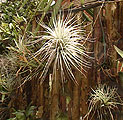
This strange ‘air plant’ occurs naturally from Argentina to the southern United States, including the Louisiana bayous. It is not a moss at all, but a member of the pineapple family (Bromeliaceae), which is often found hanging on the branches of trees. It looks similar to Usnea, an unrelated lichen which also grows on tree branches, and this is reflected in the species name ‘usneoides’.
Plant details
Common name: Spanish moss, Old man’s whiskers
Botanic name: Tillandsia usneoides
Description: A perennial, mosslike epiphyte. It has no roots, and hangs in long grey strands from the trunks and branches of host trees. The slender stems are covered in silvery white scales which absorb moisture and nutrients from the air. Inconspicuous pale green or blue flowers appear in summer and are fragrant at night.
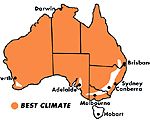
Best climate: All areas of Australia, except for Hobart and the mountains. It will grow in cold climates in a heated glasshouse or conservatory.
Uses:
Spanish moss can be grown on tree branches, or hung on fences to form an unusual privacy screen. It makes a good mulch for the garden, and an excellent packing material. It is often used for decorative floral arrangements and handicrafts. Birds use Spanish moss as nesting material. For centuries this plant was harvested commercially in America and used for mattress making and upholstery. Seats of T-Model Ford cars were stuffed with Spanish moss.
Good points:
Unusual feature or novelty plant Easy to grow Does not need watering or fertilising Attractive silver foliage
Downside:
Tiny seeds and fragments of Spanish moss are easily spread by wind and birds. In Australia there is concern that it may escape from gardens and invade native rainforest. Although Spanish moss is not a parasite, it can shade and weaken the host tree. When wet and heavy after rain it may also break branches.
Care:
Spanish moss grows in full sun to part shade. It is sensitive to frost and air pollution.
Getting started:
Ask for Spanish moss at your local nursery. It costs $12-$15 for a ‘hank’ or handful about 20cm long.