

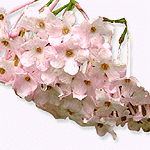
Luculia
The luculia was introduced to the west by plant hunter, Ernest ‘Chinese’ Wilson. It occurs naturally on lightly wooded hills in the lower Himalayas to Yunnan, where apparently it grows in large forests. In the home garden it’s hard enough to get one luculia to grow, let alone a forest of them, but they are definitely worth the effort. They belong to the family Rubiaceae, along with their relatives the gardenias. One of the things these plants have in common is wonderfully scented flowers, in fact the perfume of the luculia is somewhere between a gardenia and a vanilla fragrance. In our segment Don looked at the most popular species, Luculia gratissima, but there are four others including the white flowering Luculia grandiflora.
Plant details
Common name: Luculia
Botanic name: Luculia gratissima
Description: Luculias are evergreen shrubs with rounded, often irregular growth habits. In the wild they are said to reach 6 metres (20′), but in cultivation they are usually around the 3 metre (10′) mark. In winter fragrant pink flowers appear in large heads up to 20cm (8") across.
Best climate: Perth, Adelaide, Melbourne, Sydney, Brisbane and the Tropics. Protect young plants from frost.
Good points:
The flowers are magnificent. Not only do they look beautiful but they have a lovely perfume.
Downside:
difficult to grow susceptible to Phytophthora root rot flowers often ruined by rain and wind
Care:
Luculias grow well in a full sun to semi-shaded position. A free draining coarse soil with added organic material is best. They like a cool root zone, so keep the plant mulched. Do not let the soil dry out. Luculias resent root disturbance and don’t like to be transplanted.
Getting started:
Luculias are available at most nurseries. They cost around $12 for plants in 150mm (6") pots, and $21 for 200mm (8") pots.