
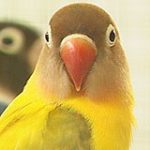
Breed: African Lovebirds
Temperament: active, noisy
Maintenance: low
Cost: $25-$200
Lifespan: 10-15 years
Recommended for: anyone
History
Lovebirds acquired their name because of their fondness for sitting in pairs while preening each other’s feathers. African Lovebirds originated in Africa and Madagascar where nine different species are recognised. It is not known when the first lovebirds were brought to Australia, but they have been kept in captivity around the world since the mid 1800s. Lovebirds have not been imported into Australia since the 1950s when expensive and lengthy quarantine restrictions were introduced.
Appearance and species
African Lovebirds are small parrots. They are stout, colourful little parrots about 13cm long with a short rounded tail. There are nine species of lovebirds (Agapornis) with four species commonly available in Australia. These four are monomorphic, which means both males and females have the same appearance.
The lovebirds available in Australia are: Peachfaced Lovebird (Agapornis roseicollis) Fischer’s (Agapornis fischeri) Nyasa Agapornis lilianae) Masked (Agapornis personata)
Today lovebirds come with many different feather colours and combinations (more than 100 are available in Australia). The original colours are known as normal colours, while any variation is usually named according to colour. For example, a Lemon Lime Fischer’s Lovebird has a lemon and lime coloured body. In the last few years, the eye-ring forms have become the most popular. The eye-ring forms (Nyasa, Fischer’s and Masked Lovebirds) have a white eye-ring around each eye. Also in demand are the normal colours in all species.
Temperament
Lovebirds are social, noisy birds that emit a high pitched and sometimes annoying chirp. They are constant chatterers and noise is a sign of contentment. The Peachfaced is particularly outgoing, even aggressive, and is often territorial. This species is not suitable for life in a colony, unless lots of space is provided, as birds may attack each other viciously. However, the Peachfaced’s outgoing personality makes it well suited to human contact and often means they make better pets then other lovebird species. As long as Peachfaced birds are given regular attention and interaction with an owner they can be kept individually or as pairs in cages inside the house. Hand-raised birds make particularly good pets. The eye-ring species do better in an aviary as they are happier in colonies and different eye-ring species can even be kept together providing they are not allowed to breed. Like most parrots, lovebirds are reasonably intelligent and can be excellent escape artists so they need a secure cage. They also like to chew and must always have something to nibble on such as non toxic and untreated pieces of wood, cuttlefish or bamboo.
Enclosure
A cage is suitable for a pet bird if the bird is kept well stimulated by the owner. Birds can be clipped and let out of the cage to interact inside the house.
For aviary birds the average structure measures 2m high x 2m long x 1.2m wide (6’x6’x4′), in which you could house five or six pairs of the eye-ring species or two or three pairs of Peachfaced. Aviaries should have a covered top and back.
Food
A small parrot mix or peachfaced mix can be bought from most pet shops and produce stores. It contains half a dozen types of seed including millet and sunflower seed. As well birds should regularly be fed greens such as spinach, endives, dandelions or thistles and will enjoy chopped fruit and vegies such as apples, corn and carrots. Wash all greens and fruit well before giving them to birds. Always provide clean, fresh water for drinking. As these birds will bathe in their water it is a good idea to place a shallow dish of water in their cage or aviary from time to time for bathing.
Health and lifespan
Lovebirds are hardy and can tolerate extremes of temperature, particularly the cool weather (although they do not like freezing conditions and must be kept away from constant draughts). In summer they should be monitored for overheating during warm weather. Lovebirds like a routine and are not happy with a dynamic environment. If a change in personality is noticed it usually means they are sick. Lovebirds will live from 6 years up to 10 to 15 years.
Breeding
It is highly recommended that pet owners contact a club or experienced breeder before attempting to breed African lovebirds. Providing lovebirds with the opportunity to breed will mean changes in behaviour and housing. It is much less complicated to keep birds for show or as pets rather than for breeding.
Cost
When interest began in breeding around 40 years ago there were only a few colours available and prices for rare or unusual colour patterns were astronomical. Today most of the colours are easy to come by and so these birds are affordable as pets. Birds cost $25-$200 each depending on the species and variety. Lovebirds are often bought and kept in pairs.
Recommended for
Lovebirds are low maintenance and economical to keep. However, if kept as a pet in a small cage, the birds do require lots of owner interaction to prevent destructive and aggressive behaviour. In an aviary situation they demand much less personal attention although daily monitoring and care is vital. It is important to remember that these are noisy birds, even when kept singly.
More information
We filmed our story with members of the African Lovebird Society of Australia. They operate Australia wide and can be contacted at:
African Lovebird Society of Australia Inc
PO Box 422
Pennant Hills, 1715
Phone: (02) 9872 2026 or (02) 9674 4256
Email:[email protected]
Website: http://nb.au.com/albs/index.html
Lovebirds are often available for purchase from major pets stores around the country, although selections may be limited.
NSW
Kellyville Pets
106B Windsor Rd
Kellyville, 2155
Phone: (02) 9629 3282
NT
Top Pets
287 Bagot Rd
Coconut Grove, 0810
Phone: (08) 8985 2491 or (08) 8985 3822
QLD
Pet City
224 Wishart Rd
Mount Gravatt, 4122
Phone: (07) 3349 2086
Freecall in Australia: 1800 245 700
WA
Guppy’s To Puppy’s
Lot 66 c&d Canning Hwy
Victoria Park, 6100
Phone: (08) 9361 9535
SA
P & K Pets
19 Magill Rd
Stepney, 5069
Phone: (08) 8362 2375
Website:www.pkpets.com.au
TAS
Eastlands Pet Supply
Shop U40
Eastlands Shopping Centre
Rosny, 7018
Phone: (03) 6244 2673
VIC
Living Jungle Pet Warehouse
170 -172 Princes Hwy
Dandenong, 3175
Phone: (03) 9794 7928
Website:www.livingjungle.com.au