
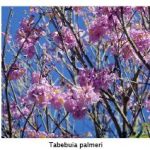
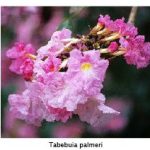
In the same league as jacarandas and poincianas, once seen in bloom a trumpet tree, cloaked in pink or golden flowers, is never forgotten.
The tabebuias (pronounced ‘tab-eh-boo-ya’) are all from tropical Central and South America and although there are about 100 natural species only about seven of these seem to be available in Australia. They could be the best seven though, because all the tabebuias we’ve seen flowering here have been jaw-droppingly spectacular.
Best climate
They’re a reasonably popular tree in Brisbane and you’ll see them in gardens and streets all the way up the Queensland coast and across the tropical north. But they’ll also grow and flower well further south – at least as far as frost-free areas in the eastern half of Sydney. The trees can stand the sort of frosts received in highland tropical areas or in Brisbane but whether they’d enjoy the frosts of western Sydney is questionable. The problem for wannabe Sydney growers is getting the plants. You never see them in nurseries there. If you live in Sydney and get a plant, you’ll need to position it where it gets full sun and preferably shelter from cold southerly winds. And remember, tabebuias grow into trees nearly the size of jacarandas.
Spring shows
Most tabebuias are deciduous or partly deciduous, losing their leaves as the tropical dry season sets in. That’s winter, and when the trees start to lose their leaves you can leave it up to the rain to water them. If none comes, so much the better because a rainy winter can lead to a poor flowering display. In September, the bare branches suddenly burst into bloom and just as a jacaranda becomes a hazy mass of blue, tabebuias turn pink or golden yellow, depending on the species. Their leaves follow the flowers.
The plants grow through the spring and summer and can take any amount of summer rain and humidity, although they don’t need daily tropical downpours to succeed. On the other hand, if summer is hot and dry you need to give them at least a fortnightly deep, deep soaking.
Story by Geoffrey Burnie, from Burke’s Backyard magazine, November 2006 issue