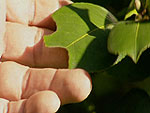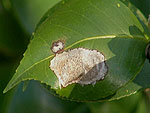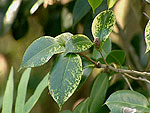
Don looked at a camellia that appeared to have quite a few leaf problems. Rounded sections from some leaves were completely missing; some leaves had yellow blotches, while others were covered in dry, silvery brown patches. However, closer inspection revealed that the camellia was a normal, healthy plant and there was nothing to worry about.
Mosaic
Yellow leaves can indicate that a plant is suffering from a nutrient deficiency or is affected by cold weather, but yellow blotches on camellia leaves are often caused by a virus. Normally only a few leaves show symptoms, which can range from a few spots to almost the whole leaf being yellow. This unnamed virus is associated with marbled flower colours, and camellia breeders sometimes deliberately infect plants to achieve particular colour combinations in the flowers. Control measures are not necessary, as the overall vigour of the plant is not affected. The virus cannot be cured but if you wish you can simply trim off any shoots which have yellow leaves.
Sunscald
The brownish black areas on the leaves of the plant were caused by excess direct sunlight. These areas turn yellow at first, then gradually darken as the tissue dies. Often the dead tissue is then infected by secondary fungal pathogens. Japonica and reticulata camellias are more susceptible than sasanquas, so they are best planted in sheltered positions with protection from the hot midday sun.
Leaf Cutting Bee
Various insects can chew leaves, including leaf hoppers, grasshoppers and weevils. However, when the cuts are symmetrical semi-circles they have probably been made by a leaf cutting bee. Leaf cutting bees (Megachile sp.), use the leaf sections to line their nests. The damage these insects cause is minimal, so control measures are unnecessary. Leaf cutting bee damage is most commonly seen in the garden on rose foliage.