

One of the most delightful things about life is the changing of the seasons. First the winter, with those hearty soups and the crackling and flaming of an open fire. In the spring life is renewed, with all the birds building their nests and fresh leaves appearing on the trees, followed by the heady, sensuous days of summer. Then comes one of the most precious times of the year, the autumn. That’s when clear, gentle days are filled with the russets, golds, scarlets, crimsons and the purples of all those wonderful autumn foliaged plants.
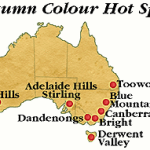
The cooler areas of Australia are the best for autumn colour – Perth, Melbourne, Sydney, the Adelaide hills, the Mountains and Tasmania.
If you live in one of those parts of Australia, you could try planting trees to give you some colour in autumn. Here are a few suggestions to get you started:
Flowering Cherry (Prunus serrulata)
There are hundreds of species of cherry; some are grown mainly for their edible stone fruit, while others like Prunus serrulata are grown as ornamentals and have beautiful flowers. Many of them, especially in cooler areas, produce outstanding autumn foliage in oranges, scarlets and yellows.
Ash (Fraxinus sp.)
The claret ash (Fraxinus angustifolia subs. oxycarpa ‘Raywood’) grows to about 20 metres (66′). It has glossy green foliage which turns claret to deep purple in autumn. The foliage of the golden ash (Fraxinus excelsior ‘Aurea’) turns a clear yellow in Autumn. It grows to around the 15 metre (49′) mark, and has yellow branchlets with conspicuous black buds.
Nyssa or Tupelo (Nyssa sylvatica)
Nyssas grow to around 10 metres tall (33′). They look wonderful in autumn because the tracery of dark stems and branches contrasts beautifully with the yellow, orange, red and crimson foliage.
Liquidambar (Liquidambar styraciflua)
These large, fast growing deciduous trees can reach 25 metres (82′) high. The autumn foliage is spectacular, with colours ranging from yellow, orange and scarlet to purple. There are new varieties available, including ‘Gumball’, ‘Gold Dust’, ‘Parasol’ and ‘Rotundiloba’.
Linden, Lime tree (Tilia x europaea)
These are very large, handsome trees often grown in Europe. They are very popular as shade trees in streets, parks and avenues, because they’re fast growing and pollution tolerant. Lindens will also grow in a variety of soils, but they need plenty of water. Their autumn foliage is yellow, and they do best in cooler areas such as Melbourne, Hobart and the Mountains.
Japanese Maples (Acer palmatum)
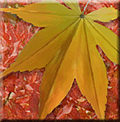
Few trees can rival maples when it comes to a magnificent foliage display in autumn. In Australian gardens Japanese maples are particularly fashionable. They grow well from Sydney to Perth and areas south, in the Mountain zones, and Tasmania.
There are hundreds of cultivars available, and there is a huge range of leaf shapes and colours, and varying growth forms. Even seedling grown trees have attractive leaves and good autumn colour. The cultivars are normally divided into two groups, according to their foliage types: The palmatum group normally has 5 to 7 lobes as in the parent species. One of the very popular cultivars in this group is ‘Osakazuki’ which turns orange, scarlet and crimson in autumn. Another is ‘Sangokaku’ (formerly known as ‘Senkaki’). This variety has golden-yellow autumn foliage and brilliant red stems, and it is commonly known as the red-stemmed maple or coral-bark maple. The palmatum ‘Dissectum’ group has fine, deeply cut leaves with 7 to 11 lobes. They have a weeping growth habit and are usually grafted onto standard understocks to form dome-shaped shrubs. Members of this group include ‘Dissectum Atropurpureum’ (claret-red foliage turning deep orange and crimson in autumn), and ‘Dissectum Ornatum’ (yellow-orange and crimson in autumn).
Getting started:
Go along to your local nursery. They will have a range of autumn foliage plants in stock which are suitable for your climate and situation.