
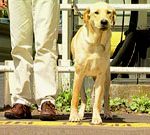
Guide Dog Association
Guide Dog Associations are probably best known for providing Guide Dogs to people who are blind or visually impaired. What many people do not know is that in addition to breeding and training Guide Dogs, Guide Dog Associations offer a range of other services, all free of charge to people who are blind or visually impaired. These services include mobility training for people who have suffered visual impairment caused by neurological trauma or damage. There are also Visiting Pets as Therapy programs in some states.
Each fully qualified Guide Dog costs in excess of $18,000 to train but are supplied free of charge to people who need them.
Why do people need Guide Dogs?
Individuals suffer blindness and visual impairment from a number of causes including; Retinitis Pigmentosa stroke head injury or brain trauma post operative damage damage to the eyes
Guide Dog Association Breeding Programme
Guide Dogs need very special qualities. In 1964 the Guide Dog Association of Victoria established a breeding programme with the intention of breeding dogs for task specific genes. The aim is to develop a gene pool which will ultimately produce dogs which are the best at completing certain tasks.
The breeding programme selects dogs on the basis of temperamental characteristics and physical attributes. The programme uses scientific data and genetic analysis to improve fertility and conception rates while seeking to minimise skeletal, neurological, opthalmological, skin and other genetic diseases. Arguably these are the best purebred dogs in the world, in that no other dog breed is so carefully selected for temperament and soundness.
Why are Labrador Retrievers used as Guide Dogs?
The Labrador Retriever is the breed most commonly used for Guide Dog training throughout the world. They are preferred because they are highly trainable and have placid temperaments. The Labrador is a responsive, intelligent dog which learns quickly. Its greatest asset is its willingness to please. Labradors also have a very positive community image.
Selection Criteria for Guide Dogs
Among other things such as temperament and health, Guide Dogs are selected for their ability to ignore their natural instincts.
Ideal Guide Dog
- people focused dog
- displays high level of willingness and initiative
- non excitable
- exceptional concentration
- appropriate level of hearing and body sensitivity
- confident
Unacceptable for a guide dog
- dog focused dog
- excitable
- exhibits unacceptable levels of anxiety or excitability
- easily distracted by noises, cats or other dogs
- unacceptably high or low levels of body and hearing sensitivity
- fearful or timid
Guide Dog Training techniques
Guide Dogs are trained using positive reinforcement. They are praised every time they make the correct choice or exhibit the desired behaviour. Guide Dog trainers use a position of trust and leadership to teach the dog all the skills which will enable it to function as an effective Guide Dog. This includes finding a safe path, stopping at kerbs and avoiding obstacles such as overhanging branches. Dogs learn to ‘find’ certain objects (doors, counters etc) on command, as well as board public transport and find a seat for its handler. The dog is taught to disobey a command when its handler has not heard an approaching vehicle – this is called “intelligent disobedience”.
At the completion of their training, graduate dogs are matched with a vision impaired person who has been assessed for their readiness to commence a Guide Dog instruction programme.The matching process is well researched and analyses each client’s lifestyle, personality, mobility and physical attributes. Clients then undergo a one on one Guide Dog instruction residential training programme.
At the conclusion of the training programme, instructors return home with the client and transfer the learning to the client’s actual home environment. Follow up visits are paid after one, three, six and twelve months to ensure that there are no problems. The Guide Dog team of handler and their dog are assessed annually thereafter.
Working Life of a Guide Dog
Guide Dogs have a working life of around 9 to 10 years. This means that the average person may have 3 to 4 or more Guide Dogs throughout their lifetime. The loss of a Guide Dog is particularly difficult as owners are so reliant on the dog that they are much more than just a pet. The Guide Dog client is given the opportunity to keep their retired Guide Dog when they train with their new dog.
Want to make a Donation?
Guide Dog Associations receive minimal government funding and rely on the generosity of individual donors, supporters, the corporate sector, bequests and Trusts to continue their important community work. Burke’s Backyard is donating $5,000 to the Guide Dog Association of Victoria to contribute towards getting some of the dogs from the Association’s breeding scheme out into the community to develop a breed of better pets for people. To make a donation please contact the Guide Dog Association in your state (all donations over $2 are tax deductible).
Further Information
VIC Guide Dog Association of Victoria
Phone: (03) 9854 4444
NSW and ACT
Guide Dog Association of NSW and ACT
Phone: (02) 9922 4211
QLD
Guide Dogs for the Blind Association of Queensland
Phone: (07) 3261 7555
SA and NT
Guide Dogs Association of SA and NT Inc.
Phone: (08) 8203 8333
TAS
Royal Guide Dogs for the Blind Association of Tasmania
Phone: (03) 62321222
WA
Association for the Blind of WA Inc.
Phone: (08) 9311 8202
Internet site: www.guidedogs.com.auClick here for our fact sheet on Labrador Retrievers.