
Firetail Finches
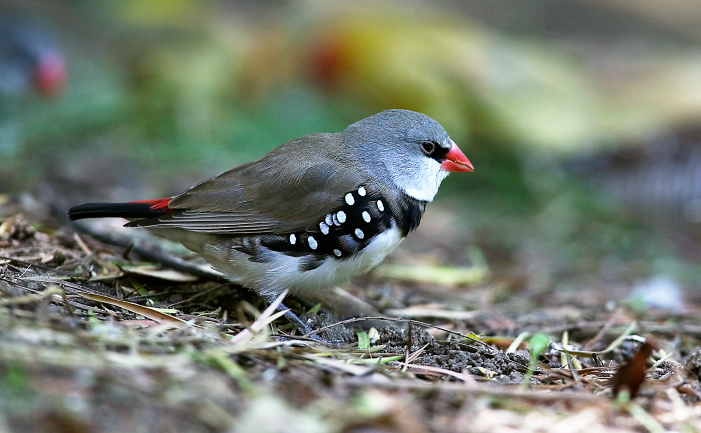
The Beautiful Firetail finch (Emblema bella) has an olive back, finely-barred underparts and a bright red rump. The males are blacker underneath than the hens, and the juveniles are duller in colour than the adults. Beautiful firetails live in coastal heathland and open scrub country, and range from around Newcastle in New South Wales to Kangaroo Island, South Australia and Tasmania. However, they are rarely seen and their populations seem to be declining in the wild.
Captive breeding
There is concern that the beautiful firetail finch may become extinct in the wild, so aviculturists are trying to ensure their survival by breeding them in captivity. If the birds do become extinct, it is hoped that wild stocks may be replenished from captive populations. Unfortunately beautiful firetails are incredibly difficult to keep in captivity, let alone getting them to breed.
Wonderful news
In our segment Don announced some very special new additions to Burke’s Backyard. His pair of beautiful firetails has just produced three chicks, and Don is hoping that they will breed again soon.
The aviary they live in is situated in a secluded area of the garden. It measures about 10m x 4m x 2m, and is planted out with native food plants and native seeding grasses. The birds particularly love eating the seed of a weed called guinea grass (Panicum maximum).
Chickweed is also a great food for birds, but it must not be confused with a similar-looking weed called petty spurge (Euphorbia peplus). Petty spurge (which belongs to the same plant family as poinsettia) contains a white, milky sap that is toxic to many birds.
Further reading
‘A Guide to Australian Grassfinches – Their Management, Care & Breeding’ by Russell Kingston. Published by Australian Birdkeeper Publications (1997) ISBN 0 9587102 28.