
|
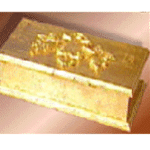
Gilding is a craft technique which allows you to introduce highlights of gold to objects in your home. To demonstrate this ancient craft, which uses real gold or a cheaper gold-like alternative, new Burke’s Backyard reporter craft expert Tracy Marsh gilded a plain wooden box. She also showed how edible gold leaf can be gilded on to food such as fruit and chocolate. |
Gilding is a craft technique which allows you to introduce highlights of gold to objects in your home. To demonstrate this ancient craft, which uses real gold or a cheaper gold-like alternative, new Burke’s Backyard reporter craft expert Tracy Marsh gilded a plain wooden box. She also showed how edible gold leaf can be gilded on to food such as fruit and chocolate.
Gilding a box
What you need a plain wooden box. Tracy bought a box from a craft shop for $15-$16 and added a decorative moulding (also available at craft shops for a few dollars) to its lid. Made from resin or latex, these mouldings are glued to the top of the box with a rubber cement adhesive.
acrylic paint. We used a terracotta coloured acrylic paint Jo Sonja Raw Umber ($5.25 a tube and readily available at craft shops) as the basecoat or bole. Terracotta colour is a good choice for a basecoat as the colour gives depth to the gold leaf overlay. Tracy applied two coats over the entire box.
gilding size. Size, a type of glue, is applied to the painted surface. Use a very thin coat, working it well into all the little fissures and cracks. Leave the size to dry for a couple of hours. When it is ready to gild it will be completely clear and will ‘click’ when tapped with a knuckle.
gold (either Dutch metal or gold leaf, which is 24 carat gold). For a box Dutch metal (a metal alloy of 90% copper and 10% zinc) is suitable. Dutch metal is not safe for food or surfaces used to serve or display food. Real gold, 24 carat gold leaf, however can be eaten and is safe to use on food. Both forms are sold by craft shops or artists’ suppliers as thin sheets, sandwiched between tissue paper.
a soft-bristled brush. We used a half inch paint brush.
polyurethane, paint or an acid such as bleach or lemon juice as a finishing coat.
Gilding step-by-step
Step 1: Wash your hand thoroughly before touching the gold. This is done to remove any skin oil which may tarnish the gold.
Note: Although cotton gloves or talcum powder are often recommended when handling gold for gilding, Tracy says these can affect the tackiness of the sized surface. She recommends clean, oil-free bare hands.
Step 2: Take the thin sheets of Dutch metal while they are still sandwiched between tissue paper and cut them into smaller squares (about 5cm or 2″ square).
Step 3: To use the gold, remove it from the tissue. Take a square and, literally, let it float onto the surface of the prepared box. With a small, dry paint brush rub the gold leaf onto the surface and into the grooves of the moulding. Don’t panic if there are fine cracks as these add character. Large cracks, if regarded as unacceptable, can be patched with off-cuts from the gold leaf. Continue adding squares of gold until the whole box is completely covered.
Step 4: To finish use one of the following: seal with a coat of clear polyurethane for a solid gold effect;
age to add character. There are two aging techniques, antiquing or oxidising. a. For an antique finish, use a soft brush and apply a mix of one part Jo Sonja Raw Umber to one part Jo Sonja Antiquing Medium (around $10 per bottle). Paint this over the sealed and gilded surface. Before it dries, wipe away most of the paint with a soft cloth (muslin is ideal). When it is dry seal with a coat of clear polyurethane sealer.
b. For an oxidised effect apply a simple acid (such as bleach or lemon juice), over the unsealed surface after it’s been gilded. Unlike the antiqued surface the oxidised surface is usually left uncoated until the desired effect is achieved – up to two weeks – then it is sealed with a polyurethane sealer.
Gilding food
Foods such as fruit, nuts and chocolate can also be gilded to lend an exotic touch to dinner parties, weddings or special occasions.
Note: 24 carat gold leaf must be used if the food is to be eaten. It’s more expensive than the (inedible) Dutch metal that was used on the box.
What you need:
- fruit, nuts or chocolate to gild (fruit should be at room temperature)
- a soft cloth
- a small bowl and fork (for mixing up gelatine)
- boiling water
- gelatine
- a flat, soft-bristled brush
- 24 carat gold leaf
Step-by-step
Step 1: Wipe the fruit with a soft cloth so its surface is free of wax.
Step 2: Use gelatine as size. To make up gelatine follow directions on packet, pouring a little boiling water into the bowl, and sprinkling over gelatine. Stir with fork to dissolve completely.
Step 3: With a clean, new brush, randomly dab gelatine onto the surface of the fruit you will be gilding. Leave it to dry so it is tacky (about an hour). Hint: Vary the way you paint on gelatine to create variation in the look of each piece of fruit.
Step 4: Once the gelatine is tacky small pieces of the 24 carat gold leaf can be patted onto the surface. Brush away any excess.
Note: Approval for the commercial use of gold and silver on food has not been requested until recently and is currently being considered.
Further information
1. Further reading: The Gilding Kit by Glenn McDean comes complete with bole (undercoat paint), size, Dutch gold leaf and sealer, as well as detailed instructions and project ideas. It’s published by Reader’s Digest Press and costs about $50. It should be available through most major bookstores.
2. Gilding materials: Materials are available at large craft stores or artists suppliers. 24 carat gold leaf may be hard to find. Dutch gold leaf cost $7.50 for a packet of 10 sheets (each sheet measure 16cmx16cm). 24 carat gold leaf costs $70 for a packet of 25 (each sheet measures 8cmx8cm).
Tracy Marsh will be presenting craft and decorating ideas on Burke’s Backyard and her segments will be featured each month in the new Burke’s Backyard magazine (first issue out on 17 June 1998). Her passion for craft has been lifelong and her first publication, Touch of Nostalgia, at the age of 19, sold more than 200,000 copies. She has a very practical approach to craft and is at the forefront of the latest trends and fashions.