
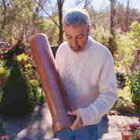
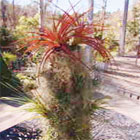
Don showed how to create some high-rise garden style using tillandsias, glue and an old terracotta pipe.
How it was done
1. Don used an old glazed terracotta pipe, but a wooden pole or even a tree branch will work well. Light wooden poles may be hung, providing an ideal amount of air movement for the plants. You can also tie the tillandsias onto a metal or wire support.
2. Don attached a variety of species including Tillandsia fasciculata, T. fasciculata cvs., T. aeranthos and T. usneoides (Spanish moss).
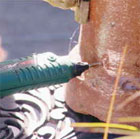
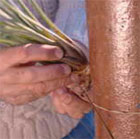
3. The base of each plant was attached to the pipe using a hot glue gun (do not glue over the roots). Many tillandsias are purchased already attached to a piece of wood that can simply be glued to the pipe. (Tip: before attaching the plants, hook them onto the pipe using rubber bands. When happy with the arrangement, glue the plants into place.)
4. The key to using hot glue with tillandsias is to only use a few drops, and wait a few seconds before pressing the plant into the glue. Even though the immediate tissue adjoining the glue might suffer a bit of damage, most tillandsias soon produce aerial roots and grow perfectly well.
5. Don draped Spanish moss (T. usneoides) around the glued tillandsias. (Note: for centuries T. usneoides was harvested commercially in America and used for mattress making and upholstery. Seats of T-Model Ford cars were stuffed with Spanish moss.)
6. A potted Orthophytum cv. was placed in the top of the pipe.
7. The finished tillandsia pole was placed in an airy position.
About tillandsias
Tillandsias are a mysterious and amazing group of plants belonging to the pineapple or bromeliaceae family. There are over 500 recognised species of tillandsias and many more in cultivation. Their native habitat is the southern United States, Mexico and Central and South America.
Like many other bromeliads, these plants are what are known as epiphytes or ‘air plants’. This means that most species don’t require soil to root in, but survive and thrive growing above the ground, hanging on tree branches or other structures. They do not feed off their host like a parasite would, rather they have adapted a means of absorbing moisture and dissolved nutrients through special scales in their leaves called ‘trichomes’. In nature these nutrients are provided by decaying leaves and insect matter diluted by rainfall.
Like other famous bromeliads such as vriesias and aechmeas, most tillandsias start off as a single plant which grows to maturity (reaching different sizes and forms, depending on the species). Then, when in season, some of them send up a spectacular flower spike that lasts several weeks, sometimes months. When the blooms finish the parent plant will then produce new plants from the base, known as pups, that will grow up and around the parent as it dies off.
Growing conditions
Some tillandsias need protection from frosts. They like a position in indirect light or filtered sunlight under trees, with morning sun only. There must be good air movement around the plants.
Water your tillandsia pole using a mist spray. Spray fortnightly in winter and at least three times a week in summer. (Note: the orthophytum needs to be watered and not mist-sprayed.)
Feed occasionally using a half strength solution of liquid fertiliser (such as Aquasol or Thrive) when misting.
Costs
Glue guns cost around $12 from hardware stores.
Spray mist bottles cost about $1
Tillandsias cost around $5-20 for mature plants. They are available through your local nursery or specialist bromeliad nursery.
Orthophytums cost around $15 for 150mm (6″) pots.

Further information
This story is in the August 2004 edition of the Burke’s Backyard Magazine. It is available at newsagents and supermarkets for $5.70.
Our segment was filmed at:
Bromeliads Australia. It is a wholesale nursery, but opens to the public by appointment. Phone (02) 4359 3356 or 0418 471 754.