
Trees, particularly native trees, in gardens need care and attention so that they stay healthy and safe. A tree that is living in your backyard is under a lot of stress compared to the same species in the bush.
To highlight this, Don contrasted the growth of a large blue gum (Eucalyptus saligna) in a suburban backyard and the same tree in the nearby bush.
The tree in the backyard had soil built up over its roots from when the house was built. Nearby was a cement slab and incinerator. As well, lawn was being grown near the tree which would be competing with the tree’s roots system for nutrients. The lawn was also raked regularly to remove fallen leaves, bark and twigs.
Further afield, the surrounding houses, roads and footpaths have altered the amount of natural run-off the tree receives, compared to what it would have had before the area was subdivided and houses built.
In contrast, the tree growing in undisturbed bushland had a rich mulch of leaves built up around its base. This mulch nourishes the micro-organisms in the ground and helps to feed the tree. In the bush soil levels had not been altered and the tree appeared to be strong and healthy.
Closer examination of the backyard tree showed that it was stressed. There was evidence of a bullseye borer in the main trunk (caused by the larvae of one of the longicorn beetles).
Borer attack is a sure sign of stress as a healthy tree would be able to repel such an attack. Signs to look for in your tree include holes in the trunk or branches (especially holes that look like a bullseye), oozing gum, a build up of frass or fine wood shavings, or die back of branches.
Treatment
The backyard gum tree Don looked at needed immediate attention. Don’s main concern was to get nourishment to the sick roots and to allow the soil to re-establish a healthy population of micro-organisms. Achieving this would get the tree growing again and hopefully help it resist the insect attack.
To do this Don treated the tree with a liquid called Seasol. Research has shown that this particular product can help to invigorate the roots, possibly by encouraging the growth of beneficial soil micro-organisms, particularly mycorrhizal fungi normally associated with the tree’s root system.
When the soil micro-organisms are present they help the tree roots absorb nutrients needed for growth (including phosphorus, zinc, manganese and copper).
Don recommends that the Seasol be applied regularly for several months before any fertilising is done. Straight applications of chemical fertiliser can harm the micro-organisms and make the problems worse. Once the tree is starting to respond to the Seasol treatment Don suggests applying an organic fertiliser such as Dynamic Lifter or blood and bone, which will not harm the new population of soil organisms.
As an alternative he recommends the use of slow-release tree tablets, which deliver nutrients to a small area, directly where they are needed by the tree. The use of sulphate of ammonia or complete lawn food is considered bad and should be avoided.
How to apply
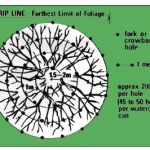
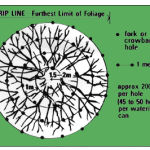
For the best results the Seasol should be applied to the feeding roots. These are to be found in a doughnut-shaped band around the tree trunk, inside the drip line. The drip line is simply the outer extent of the tree’s canopy (leaves) – literally the area of the ground where water drips from the leaves after rain.
Taking a garden fork Don went around the tree, inside the drip line but no closer than about a metre to the trunk (0.5m for a small tree), and plunged the fork into the soil to make a series of holes in the ground. As a guide, around 20 – 30 holes is needed for a small to medium tree.
Don then fed the tree roots by watering diluted Seasol into these forked holes (see diagram).
Recommended dose
Don recommends following the dosage instructions on the package. He applied one cup of Seasol to a standard nine litre watering can of water (250ml to 10 litres of water). He filled up each of the forked holes with this liquid and recommended the treatment be applied every month for six months.
Once the tree is growing (usually after two to three months) apply a granular fertiliser or tree tablets at the rates recommended on the packet, which will depend on the size of the tree. As a guide:
- Trees up to 5 metres (small trees ) – 1kg of fertiliser
- Trees 5-10m (medium trees) – 2 to 5kg of fertiliser
- Trees over 10m (tall trees) – 5-10kg of fertiliser
The granular fertiliser or tree tablets should be placed into a hole in the ground. The hole will need to be larger that the forked holes. Don recommends making a hole about 25cm deep by using a crowbar. Holes should also be made under rocks and paths if they are in the root area.
Once the tablet has been placed in the hole, back fill.
In addition to regular applications of fertiliser, the tree should also be given a deep watering once a week in summer and around once every three weeks in winter.
If you are in any doubt about the health or safety of a large tree in your garden, contact a registered tree surgeon.
Details
Seasol is a concentrated liquid made from Tasmanian bull kelp (Durvillaea potatorum) harvested along the southern Australian coast. It is available at most nurseries and hardware stores. If you have trouble locating some at your nursery, contact the distributor, Ground Cover Fertililsers on (03) 5941 3988 for your nearest retailer.
Dynamic Lifter, Blood and Bone and various brands of slow release tree tablets are also available through your local nursery or hardware. The tablets Don used are produced by Langley Fertilisers and are produced in Western Australia. For the nearest stockist, contact the manufacturers in Melbourne on (03) 9729 6511.