
Growing your own plants from a cutting is one of the most satisfying things you can do when gardening. The cuttings can be taken during late spring and summer and grow readily. Plants that can be grown from cuttings include; Coleus, Verbenas, Double impatiens, Geraniums, Marguerite daisies, Lavenders, English box, Japanese box, Fuchsias, Rhododendrons, Gardenias, Azaleas or Hebes.
What you need:
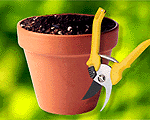
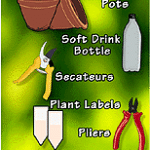
sharp secateurs
good propagation mix (1 part perlite (from your local produce store) to 1 part peat moss (from your local nursery)) or alternatively seed raising mix
old clean pots (10-15cm (4-6″) diameter)
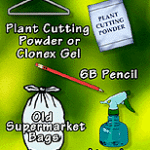
hormone rooting powder or gel such as Clonex (available at nurseries for about $7.95)
an opaque plastic bag or plastic bin liner
elastic bands
coathanger for some bent wire (to make a mini-greenhouse around the pot)
pliers
polystyrene vegetable box or plastic soft drink bottle
glass with bevelled edges to cover polystyrene box
dibbler (for example a pencil to make holes in the mix)
bucket of water with Dettol or bleach (to sterilise equipment, pots, hands etc)
Artline marker or 6B pencil and labels
atomiser for spraying water
Semi-hardwood cuttings:
-
Fill sterilised pots or a propagating tray with moist propagating mix then you are ready to plant some cuttings.
- Box, camellias, azaleas and many other shrubs can be grown from semi-hardwood cuttings. This type of cutting uses wood which has hardened off (it is not the soft new growth), generally a month or more after the flush of new growth has occurred. As a guide, the stem below the new shoot will be starting to look brown rather than fresh and green.
- To test whether the cuttings you are taking are suitable bend the growth gently, it should bend and snap if it is a true, semi-hardwood cutting. If it just bends but doesn’t feel as if it will snap, it is too soft.
- The best type of growth for semi-hardwood cuttings is found in late spring and summer (November to February).
Hint: When taking cuttings of a plant such as box that you may be planning to use as a hedge, take lots of cuttings to allow for spare plants to replace any that may die in the hedge.
- Take cuttings about 6-10cm (2 1/2 – 4″) long and around 4-8mm (1/4″) in diameter.
- Select cuttings from a healthy, vigorously growing plant.
- Don’t allow cuttings to dry out between removing them from the plant and potting them. If you have to transport the cuttings, wrap them in damp newspaper and a plastic bag and keep them cool.
- Remove most of the leaves along the stem.
- Strip leaves off with fingers or nip them off with sharp secateurs, leaving a cluster of several leaves at the tip.
- Dip base of cutting into hormone rooting powder or gel to increase the strike rate.
- Using the dibbler, make a hole in the propagating mix and insert the cutting. Put several cuttings into each pot and firm around each cutting.
- Write the name of the plant on a label and stick it in the pot.
- Water gently and cover pot with a plastic bag making sure there is moisture inside the bag.
- Use an old coathanger over the pot to form an arch to keep the plastic bag from collapsing.
- Alternatively if you have a small enough pot, use an old soft drink bottle with the bottom cut out of it and simply place it over the pot.
- The advantage of the bottle is that you can remove the lid for a week or two when you want the cuttings to harden off. If you are doing lots of different cuttings, another option is to use the polystyrene box with a sheet of glass on top for a lid.
Stand pot in a shady spot that gets good filtered light but no direct sun. - Check periodically to see if more water is needed and spray water onto the cuttings.
- Propagating mix should not dry out or the cuttings will die.
Plants will have begun to form roots after about eight to 12 weeks (quicker for plants such as impatiens, geraniums or marguerite daisies). They will feel firm in the mix and may have started to show new shoots. - Allow some air into the greenhouse, either by making slits in the bag, taking the lid off the bottle or sliding the glass lid open about 5cm (2″) for a couple of weeks to harden off the plants a little. They can then be taken out of the pot and potted up into individual pots in potting mix or into the garden.
Cost and availability
Perlite is available from some nurseries (5L costs $8.95) and produce suppliers (100L costs $22).
Peat moss is available from nurseries, 30L costs $12-$15.
Seed raising mix, 5L costs $6.80.
Clonex rooting gel costs $7.95.
Further information
There are some books specifically about propagation for home gardeners which may help you to try growing new plants:
Cheap and Easy Propagation by Jane Edmanson (Lothian Australian Garden Series, 1991), rrp $16.95.
Modern Plant Propagation by Allan Gardiner (Lothian, 1988), rrp. $24.95.