






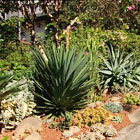
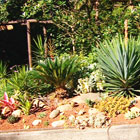
Water-wise gardens are becoming more and more important as the drought bites hard and water restrictions are in place in many part of the country. Don showed a garden that will grow and survive in the driest areas of Australia, because it has mostly been planted with succulents.
Choose succulents
Succulents store water in their leaves, stems or roots to help them withstand the severe drought conditions of their native habitats. They also have other adaptations to reduce water loss through transpiration, such as hairy or waxy surfaces.
Succulents have an amazing diversity of leaf shapes and colours. They create strong focal points in minimalist designs and their evergreen foliage makes them ideal for small urban gardens. They also make ideal container plants.
The garden in our segment was mulched with red scoria, which retains moisture and doesn’t need replacing on a regular basis (red scoria costs about $160 per tonne from landscape suppliers). Plants in the garden include:
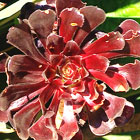
Aeonium (Aeonium arboreum ‘Schwartzkopf’)
This succulent has dark, almost black leaves and a candelabra-shaped branching pattern. It likes well-drained soil and a position in full sun to light shade. It is not frost hardy. This plant is easy to propagate from cuttings.
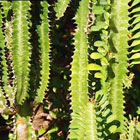
African milk tree (Euphorbia trigona)
A small shrub to 3m (10′) tall. It has green stems with cream-green mottling becoming grey with age. Spines are regularly spaced on each rib. Euphorbia flowers have no petals or sepals, just modified coloured leaves designed to attract pollinating insects.
Agave (Manfreda spp.)
Belonging to the Agavaceae family, this perennial herb has succulent roots. The scarcely succulent foliage of manfreda is soft and usually marked with pink, brown or purple. It is quite distinct from the firm, fleshy leaves of the agave. Manfreda spp. require more water during the growing season than agave.
Bromeliads (Bromeliad sp.)
Native to tropical America, bromeliads are members of the Bromeliaceae, or pineapple family. These plants come in a wonderful variety of sizes, shapes and foliage colours. Many of them are epiphytes, in other words they live up in the forks of tree branches and exist mainly on the moisture and nutrients they obtain from the air.
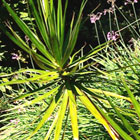
Dracaena (Dracaena marginata)
Known as the red-edge or Madagascar dragon tree, this dracaena has narrow, pointed green leaves with red to purple stripes along the outer edge. It is a slow grower to around 5m (15′) tall. It makes a great, low maintenance accent plant either indoors or outdoors.
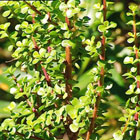
Jade plant (Crassula ovata)
A branching shrub from South Africa, growing from 1-2m (3′-6′) tall. The leaves occasionally have red edges. Clusters of small, pinkish-white flowers appear in winter.
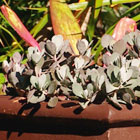
Kalanchoe (Kalanchoe pumila)
A small, succulent shrub native to Madagascar that grows to a height of 20cm. In full sun, the silver leaves develop a reddish-purple colouring. The mauve-pink flowers have four petals and appear in late winter.
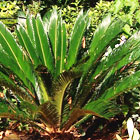
Sago palm (Cycas revoluta)
This is the most widely cultivated cycad in the world. It is slow growing to around 3m (10′) tall, and has a compact crown of dark green, feather-like leaves, made up of crowded, narrow, spiky leaflets. Sago palms are hardy, and will tolerate drought and light frost. They do best in a sunny position with good drainage, and benefit from applications of mulch and fertiliser during the warmer months.
Caring for succulents
The ideal potting mix for succulents in containers should contain half coarse sand and half free-draining potting mix. Keep the mix barely moist when planting and don’t water for the first week. A six month slow release fertiliser such as Osmocote is recommended.
A well-drained sunny aspect is the ideal situation for growing succulents. Insufficient sunlight will cause the succulents to become leggy, distorted and lacking in colour. Place containers under the eaves in cold areas which experience considerable winter rain, but in positions where they still receive sun.
Because succulents are often brittle, stems or leaves may break off when handled. Don’t worry, succulents grow easily from cuttings. Simply set aside the broken piece for about a week or so, until it dries out. Then insert into a tray or pot filled with 50:50 potting mix and washed river sand. Before you know it, you’ll have a new plant!
Further information
You’ll find a good range of succulents at nurseries and specialist nurseries, including:
NSW VIC
Valley View Nursery
19 Bay Road
Arcadia
Phone: (02) 9655 1550
Collectors Corner at Garden World
Springvale Road
Keysborough
Phone: (03) 9798 5845
Gill’s Nurseries
1 Centre Road
Brighton East
Phone: (03) 9592 8711 SA WA
The Conservatory
80 Unley Road
Unley
Phone: (08) 8272 9657
Fraser Giftware and Garden Centre
Cnr Fraser and Comrie Roads
Canningvale
Phone: (08) 9455 1174 TAS
Chandlers Nursery
75 Queen Street
Sandy Bay
Phone: (03) 6223 5688