
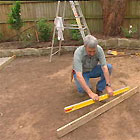
The main function of a lawn is to evenly shed water during periods of rain, so when putting in a lawn it is critical to get your base levels right. When preparing to lay turf for our French makeover, Don first checked the natural fall of the land and found that it was sloping towards the back diagonal corner. As he graded or levelled off the area, he constantly checked his level to make sure that the water would sheet off in that direction. (Tip: placing your level on a long piece of timber makes it easy to check the direction of the slope.)
Once Don was satisfied that the base levels were spot on, he used turf underlay to build the area up to the height of the timber path edging. Turf underlay (a combination of soil, sand and organic materials) is spread about 100mm (4″) thick and levelled with a topsoil leveller.
Laying turf
Turfing can be done almost all year round, other than in very cold areas.
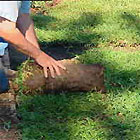
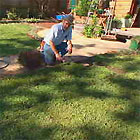
1. Roll out the turf starting along the longest straight edge, have your runs lay across a slope to avoid erosion, and stagger your joints.
2. Cut to shape with hedge shears or a spade where required. (Tip: prior to laying keep turf moist and in the shade.)
3. Roll with a lawn roller to ensure roots are in contact with the soil.
4. Water well until established. (Note: check with your local water authority on water restrictions and possible exemptions for new lawns.)
After care
Don’t mow your new lawn for one or two weeks – wait until it settles and starts to grow. Mow at first on a high setting, and then gradually lower your mower setting. Be very gentle with your new lawn – you may also have to restrict foot traffic on the lawn until it is established. See below for lawn watering tips.
Lawn types
Make sure you choose the right lawn type for your area. Lawns are classed as either warm season grasses or cool season grasses, depending on their growth pattern. Warm season grasses grow best when temperatures are between 20-30°C: these grow from spring to autumn. Warm season grasses slow down and go almost dormant over winter. Varieties include couch, kikuyu, buffalo, carpet grass and Wintergreen couch.
Cool season grasses grow best when temperatures are between 10-20°C. They have two main growth periods, autumn and spring. These grasses generally retain good winter colour but dislike heat and high humidity. They include bents, fine and tall fescues and Kentucky blue grass.
For the French makeover, Don used ‘Sir Walter’, a soft leaf buffalo that looks good for most of the year. It grows well in all areas of Australia, except for the coldest mountain zones and the arid inland.
Thirsty lawns
Lawns use the most water in the garden, so it’s important to be water wise in times of drought and water restrictions. Try these water saving tips: Choose water-efficient lawn varieties such as soft leaf buffalo ‘Palmetto’ and ‘Sir Walter’, as these two grasses have good drought-tolerance. Consider reducing large areas of lawn, or replacing the lawn with drought-tolerant ornamental grass such as Themeda ‘Mingo’. Water your lawn for longer, but less often, to encourage deeper roots and drought-tolerance. Aerate the lawn occasionally with a garden fork to help the water soak in thoroughly. Only water your lawn when it shows signs of stress, such as when it’s wilting or losing colour. If it springs back when you tread on it, the lawn doesn’t require water. If the lawn stays flat, it needs a soak. Make good use of products like Saturaid, which aid water penetration, and apply organic fertiliser when you get rain.
Further information
Turf underlay costs about $45-$50 per tonne and is available from landscape suppliers.