
Bromeliads are native to tropical America. Many are epiphytes, that is they live on other plants but do not parasitise those plants. Rather than growing in soil, they are found up in the forks of tree branches, surviving mainly on the moisture and nutrients they obtain from the air. Bromeliads can be quite spectacular grown in the garden, but they also make very good pot plants.
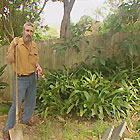
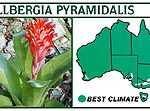
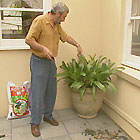
In our segment Don divided a clump of Billbergia pyramidalis. This is a vigorous, tank bromeliad from Brazil. Its broad leaves are arranged in a vase-like shape with overlapping bases, forming a natural reservoir (or tank) for water. In late summer it produces purple/blue flowers surrounded by bright pink floral leaves, or bracts. It can be grown in most areas of Australia, but may need protection from frost in colder zones.
Dividing the clump
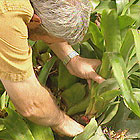
1. New plants can easily be grown from offsets (also called pups). When the offsets are about 15cm (6″) in size, just cut them away from the mother plant with a sharp knife.
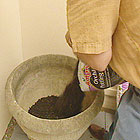
2. After thinning out the clump, Don potted up the adult plants and pups. Bromeliads require a light, open mix with good drainage, so Don used a 50:50 mix of standard orchid compost and ordinary potting mix. Before adding the potting mix, he put a few pieces of broken pipe around the drainage holes to stop soil falling out and making a mess on the paving.
3. When potting don’t forget that the leaves hold water, so it’s important to keep the central cup upright. This reservoir in the centre of bromeliads provides the plant with both water and nutrients, and in the rainforest forms a pond for tiny tropical frogs.
4. Bromeliads do best in filtered light, and they don’t like strong fertilisers. If you want to fertilise, Don suggested applying a very weak solution of a liquid fertiliser such as Nitrosol, perhaps mixed with Seasol.
Further information
Both Nitrosol (about $7.00 for 250ml) and Seasol (about $6.80 for 250ml) are readily available at nurseries, garden centres and hardware stores.
For more information on bromeliads see ‘Growing Bromeliads’ by The Bromeliad Society of Australia, ed. Barry E. Williams (Kangaroo Press, 1990). ISBN: 086 417 3369.