
Come and See My Garden – Newcastle
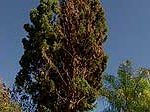
Anne Johns of Kotara, New South Wales, wrote to Burke’s Backyard asking for help. She moved into her house nine years ago. Since then, she has noticed to her dismay that all of the pencil pines (Cupressus sempervirens) along one boundary are dying. Anne does not want to lose the trees because they screen the house and protect it from the fierce western sun. After having a look around, Don talked to Anne about some of the things he thought were contributing to the problem.
20% or 30% of the tree roots would have been destroyed when a new driveway was constructed next door. It is important not to build or excavate too close to established trees.
The soil is water repellent. It is also a little too acidic (pH 5-5.5) for pencil pines, which grow naturally in the limestone soils of Mediterranean areas. To raise the pH, Don suggested Anne adds agricultural lime to the soil (as per the instructions on the pack).
Don also recommended the use of a product called Seasol. Seasol is not a fertiliser. It is a seaweed extract that promotes root development and helps stressed trees to recover. Apply according to instructions on the container.
Citrus trees are a good indicator of the condition of the soil. Citrus leaves (and the leaves of many other plants) develop distinctive green and yellow patterns which are telltale signs of mineral deficiencies. Trees in Anne’s garden showed that the soil was lacking in trace elements such as magnesium, manganese, zinc and iron. Many books (such as ‘What Garden Pest or Disease is That?’ by Judy McMaugh) include sections on essential elements, and NSW Agriculture puts out useful guides called Agfacts. Don suggested that Anne applies complete trace elements to the soil, followed up in August with a complete fertiliser (such as a complete citrus food).
Although the dying and senile trees would be almost impossible to bring back, Don thought that after removing the trees (including stumps) and doing the necessary soil preparation, Anne could plant new pencil pines along the boundary without further problems.
Summary
To help your trees and improve the soil:
avoid excavating or building near established trees
add lime to acid soils
water with Seasol
apply an all purpose fertiliser when new growth is seen
treat water repellent soils with a wetting agent
Further information
Agfacts such as ‘Magnesium and magnesium deficiencies in citrus’ (ref. no. H2.AC.3)and ‘Iron and zinc deficiencies in citrus’ (ref. no. H2.AC.2) cost 50 cents from NSW Agriculture offices. For mail orders add $2.00 per order. Order by phone on 1800 028 374, by fax on 1800 642 065, or send your order and payment to
Cashier,
NSW Agriculture,
Locked Bag 21,
Orange NSW 2800.
Judy McMaugh’s book ‘What Garden Pest or Disease is That?’ (Lansdowne Press, $50) is available from book stores or from Floriligeum, 145 St Johns Road, Glebe NSW 2037. Phone: (02) 9571 8222.