
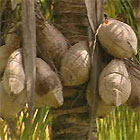
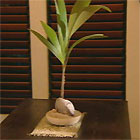
When most people think of beautiful tropical beaches, they think of swaying coconut palms, seashells and golden sand. Don showed how to create a long-lasting reminder of your tropical holiday by growing a coconut palm in your own home. Surprisingly, coconut seedlings make incredibly hardy indoor plants.
Seedling availability:
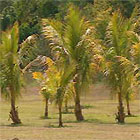
A company called Palm Plantations of Australia dry-wraps palm seedlings and sends them to most parts of Australia (except Western Australia). The seedlings sell for around $30 each, including postage. The company mostly sells varieties called ‘Malay Dwarf’, which grow about 9-15m (30-45′) tall. They are useful as fruiting trees, street plantings and lawn specimens. They cope with air pollution, poor drainage, compacted soil and drought, and they are resistant to the lethal yellowing disease. The ‘Malay Dwarf’ varieties are labelled according to their fruit colour – golden, red or green.
Potting up your seedling:
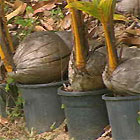
When you receive your coconut seedling, carefully sit the coconut on a bed of free-draining potting mix, preferably with a 40-50% mixture of coarse sand in a pot of your choice. The pot does not have to be deep, although if some of the coconut base can be buried with enough space for some soil at the base, your plant will probably look healthier for a longer period.
You can put a layer of sand, coconut fibre or any material of your choice on the surface of the potting mix, for decorative purposes.
To avoid rotting, keep the mixture moist but not wet.
Place the pot in a bright, sunny spot. Every now and again, put the pot outside in the morning sun for a short period, to keep the plant looking healthy.
Your palm should be quite happy growing indoors for a few years. Once it has outgrown its pot, you can plant it in a sunny spot in the backyard. (Tip: to avoid transplant shock before planting out, slowly give your potted plant extended periods of sun to acclimatise it to its new situation.)
Further information
Mail order plants from:
Palm Plantations of Australia Pty Ltd
Neville Burman
15 Lakes Street
Cairns 4870
Phone: (07) 4031 2993
Fax: (07) 4051 0461
Web: www.palmplantations.com.au