
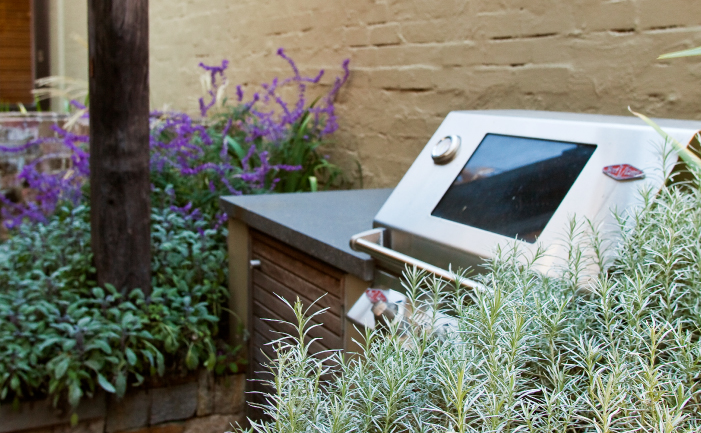
Barbecue Makeover
Burke’s Backyard visited an older style house which had been given a new modern look with a Tuscan theme. The outdoor entertaining area had been paved and retaining walls finished in a painted cement render. The original barbecue however looked out of place with its dated quarry tiles and needed a simple makeover comprising cement render and some feature tiles to blend in with the surrounding walls. This job can be easily achieved by the home handyperson in a weekend.
Step 1 Removal of the Cooktop
The gas valve was turned off and disconnected and the cooktop removed.
Step 2 Preparation of the surface
Using a scutch hammer the existing tile surface was scabbled (chipped) to provide a better key or surface for the mortar.
A brick header course using 5cm (2″) brick pavers was laid around the perimeter of the barbecue with a 3cm (1″) overhang to give a shadow line to the back of the barbecue. These bricks were laid in a mortar mix of 4 parts bricklayers sand to one part cement.
Step 3 Application of feature tiles
Three feature tiles (one large and two smaller) were chosen to continue the Tuscan theme of the courtyard. The exact position for the tiles was determined using a rule. A generous amount of maxbond adhesive was applied to the back of the tiles and they were placed into position. The tiles were then removed for five minutes for the maxbond to go “tacky” then they were firmly put in place. Being on a vertical surface it was necessary to prop the tile so that it didn’t slide down the wall.
Step 4 Slurry Coat
A slurry coat was prepared consisting of one part coarse sand (crushed quartz) and one part cement and the recommended rate of Bondcrete. It was mixed to a paste consistency and applied with a brush over the existing scabbled tiles. This coarse coat was to assist the adhesion of the render or bagging mix. It was allowed to set for eight hours.
Step 5 Bagging
The bagging mixture consisted of:
- 2 parts Sydney sand
- 2 parts bricklayers sand
- 1 part builders off-white cement
Water was added to create a thick consistency which did not run off the vertical wall. The bagging was applied with a trowel to the tiles and brick capping using a circular motion. After completion the entire surface was carefully rubbed over using a moist sponge to smooth over the trowel lines. It was important to regularly rinse the sponge in water. Any surplus cement was removed from the decorative tiles.
Step 6 Painting and Sealing
When dry, the render was painted with Porter’s Bondcote (Paddy Melon) which is a tinted cement paint. To prevent staining from fats and foodstuffs the render was sealed with Bondall Clear Paving Sealer ($29 for 2L).
Further information
The total cost of materials for this barbecue makeover was $70 and took approximately seven hours of work time to complete.
Although the colour scheme and finish was basically a Tuscan style Don showed that by placing a few Mexican artefacts around the barbecue you could easily change the theme to Mexican.