
Sugar
The sugar industry has been issuing advice that sugar doesn’t cause heart disease, diabetes, obesity or tooth decay. But are these claims true? It is certainly true that sugar doesn’t cause heart disease or diabetes, and fat intake is much more important than sugar as a cause of obesity. A little bit of sugar doesn’t do you any harm, even if you have diabetes. But it’s best to avoid large amounts of sugar and not eat too many sweet, fatty foods.
Nutritional value
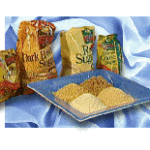
Sugar is a carbohydrate but it has no other nutritional value. It has no protein, no minerals, no vitamins and no fibre. Brown sugar, raw sugar, demerara sugar and coffee crystals don’t have any extra nutrients with their carbohydrate but they do have a stronger flavour which may help you to use less of it. So sugar is not like other carbohydrate foods such as potatoes, rice, pasta, breads, cereals, fruits, nuts and beans which are loaded with other important nutrients. Another problem with sugar is that it often keeps poor nutritional company. Sugary foods often come with a lot of fat and often the wrong kind of fat as well as artificial colouring, flavouring and preservatives. There are some foods that contain sugar which also have nutritional value. These include yoghurt, flavoured milk, custard and canned fruit. It makes much better nutritional sense to get your sweetness and carbohydrate from healthy foods like fresh fruit most of the time. There are an increasing number of foods (such as canned fruit and jams) that are sugar free or have no added sugar.
Tooth decay
The major problem with sugar is that it’s bad for teeth. Of all the health problems related to diet, the one that costs the most in Australia in the 1990s is tooth decay. The costs of tooth decay are greater than those associated with coronary heart disease (coronary heart disease costs $474 million annually and filling holes in teeth costs $478 million annually). Other foods can also cause tooth decay but sugary foods are the main culprit. Restrict eating sugary foods to times when you can brush your teeth straight afterwards and give your teeth a good long rest between sugary foods. If you can’t get near a bathroom to brush your teeth, chewing sugarless gum can stimulate the production of saliva and help a bit but it should not replace proper brushing.
Warning: There is one time when you shouldn’t brush your teeth and that’s after drinking soft drinks or sports drinks. These drinks are acidic, even the ones without sugar and a toothbrush can etch the acid into the tooth enamel wearing it away. Dentists say you should rinse your mouth with plain water after these drinks. Alternatively just drink plain water in the first place.
Further information
For more of Rosemary Stanton’s advice on food and nutrition consult:
Rosemary Stanton’s Complete Book of Food and Nutrition (Simon & Schuster, revised edition, 1995, rrp $29.95); or
Eating for Peak Performance by Rosemary Stanton, (Allen & Unwin, second edition, 1994, rrp $14.95); or
Find out about Fibre, by Rosemary Stanton, (Allen & Unwin, 1998, rrp $6.95). Includes information on sugars and starches.