
Orb Weaving Spider
Although spiders are unpopular with lots of people, they play a very important role in the garden. They assist in the pollination of plants, recycle dead plant and animal matter, and help to keep insect populations under control. John Dengate looked at a lemon tree which had been attacked by bronze orange bugs and citrus leafminer. John has approached the problem of pest control in a very environmentally friendly way. He noticed that wherever there were spider webs, there weren’t many insects. He collected large golden orb weaving spiders and put them onto his lemon tree, thus creating an effective pest barrier. Any of the orb weaving spiders would do the same job.
Bronze orange bug (Musgraveia sulciventris)
These bronze/dark brown citrus bugs are shield shaped, and have piercing and sucking mouthparts. They cause distortion of young shoots, leaf fall, fruit fall (due to feeding on stalks) and their excrement scorches the older leaves. They are found in eastern Australia.
Citrus leafminer (Phyllocnistis citrella)
The larva of this tiny, night-flying moth tunnel through the leaves and leave silvery ‘squiggles’. The damaged foliage is often twisted and curled. This pest affects both native and cultivated citrus, and is found in most of the citrus growing areas of Australia.
Golden Orb weaver (Nephila sp.)
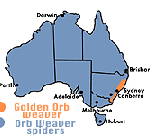
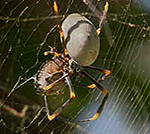
One of thousands of species of orb weaving spiders, the golden orb weaver takes its name from the web of golden silk the female spins, which is so strong it can catch small birds in mid flight. This spider is prevalent in eastern Australia, especially in the summer months. It strings its web between trees, or around the sunny sides of buildings. When an insect lands in the web the spider feels the vibrations, dashes out and catches the prey, then binds it with silk threads. The males are much smaller than the females, and sit on the edge of the web waiting for insects to be snared.
Keeping spiders in your garden
To move a spider, John suggests very carefully swirling a long stick around in the web until the spider jumps onto the stick. Then drop the spider onto the plant you want protected. (Warning: Orb weaving spiders are generally not dangerous to humans, but they can bite. They should only be handled with extreme caution.) If you want to attract a healthy population of spiders and other natural predators to your garden never use chemical sprays.