
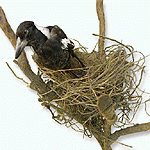
Although Australian magpies (Gymnorhina tibicen) take their name from an unrelated black and white European crow, they are essentially ground feeding butcherbirds. They live in territorial groups and keep to a fairly simple daily routine. Early each morning magpies reaffirm their territory with loud flutelike warbling, and then they leave their nests and fly to open fields to feed. During the breeding season, usually between August and November, the birds can become very aggressive and will sometimes swoop and attack people passing by. This is a good time to avoid magpie territory! Magpies make nests from twigs, sticks and grasses. However, they do commonly utilise any building materials available, including wire.
The Burke’s Backyard team recently visited the Australian Museum, which has a fabulous collection of wire magpie nests on display.
Wire nest collection
The nests usually have a big solid wire base, with a little interior cup lined with plant material to cushion the eggs. An amazing range of wire types is used in the construction including mesh, coathangers and bicycle spokes. The oldest nest in the collection dates from the turn of the century, and comes from the Cobar area. Most are from New South Wales but some come from as far afield as Western Australia, so the phenomenon itself seems to occur nationwide. Other non-wire magpie nests incorporate fishing line, rope, garden implements and even a silver bangle. Ornithologist Walter Boles of the Australian Museum regards magpies along with ravens and currawongs as intelligent birds, but he thinks the building of nests using modern materials is a very special magpie tendency.
Contact information
Australian Museum, 6 College Street, Sydney, NSW, 2000. Phone: (02) 9320 6000
Other Museums:
Museum of Victoria. Phone: (03) 9651 6777
Queensland Museum, Reference Centre. Phone: (07) 3840 7640
South Australian Museum, Information Service. Phone: (08) 8207 7404
Tasmanian Museum and Art Gallery. Phone: 03 6235 0777
Western Australian Museum. Phone: (08) 9427 2700
Museum of Central Australia. Phone: (08) 9851 1144