
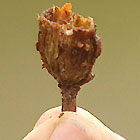
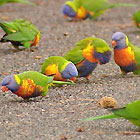
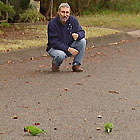
Don was interested to see rainbow lorikeets picking at something on the road. He soon realised that these clever little birds were eating the seed from capsules of Eucalyptus gummifera, the red bloodwood. The gumnuts had fallen on the road, and had already been cracked open by passing cars. Although rainbow lorikeets are nectar feeders, they do occasionally eat small quantities of seed.
Red bloodwood (Eucalyptus gummifera)
A small to medium tree growing to around 30m (100′) tall. It has rough, reddish bark, and creamy white flowers from late summer to autumn followed by urn shaped capsules. Found in open forest, woodland and coastal heaths, it prefers sandy, infertile soils. If wounded, a large amount of bright red resin (or kino) is exuded, hence the name ‘bloodwood’.
Rainbow lorikeet (Trichoglossus haematodus)
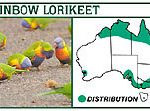
These large lorikeets have blue heads, orange breasts and brush-tipped tongues for gathering nectar from flowers. Their natural range extends from Broome in Western Australia, over to Queensland, down the east coast and round to Kangaroo Island in South Australia. Escapees from aviaries have also settled happily in Perth.
Rainbow lorikeets have benefited enormously from contact with humans, and they are much more common now than they used to be years ago. This is because homeowners have been feeding them, and also because nectar-bearing plants, such as bottlebrushes, have been planted in so many home gardens.