
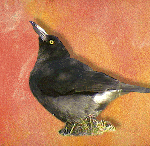
Currawongs
Increasing numbers of pied currawongs along Australia’s east coast are being seen as a threat to many small bird species, and a key factor in the spread of weeds into native bushland.
The pied currawong is a large black bird, 41-51cm (16-20″) with white markings on the wing, rump, undertail and tip of tail. They are found from Cape York to south-western Victoria ranging about 400km inland.
Today currawongs are common in urban areas although their native habitats are forests and woodlands.
Recent research shows that while currawongs have a specialised wild diet of bull ants and stink bugs and native berries, our introduced (not native) garden plants have provided a range of winter fruiting plants to eat during the colder months. Less than 30 per cent of Australian native plants fruit in winter, and so normally a lack of food culled younger and less vigorous birds.
Exotic plants including pyracantha, cotoneasters, privet and hawthorn – planted in the suburbs, as hedges – have tipped the natural balance in favour of the currawong by providing berries whose seeds are then excreted into native bushland.
Fairy wrens
There is also good evidence currawongs are targeting babies of other birds to feed their own nestlings. Currawongs have been recorded taking babies of small birds like Thornbills and Fairy Wrens, Bronze-winged pigeons and even ducklings.
Researchers attached coloured ankle rings to baby Fairy Wrens to track the birds through their lives. Many rings were discovered in currawong regurgitations. Currawongs steal baby wrens from their nest and tear them into small pieces for the young currawongs. Indigestible items, like plastic rings, are then regurgitated.
Outlook
Professor Andrew Cockburn of the Australian National University says it’s difficult to gauge the seriousness of the nest predation problem. Researchers don’t believe the currawong population has yet stabilised, it may be increasing. For many rarer birds a currawong population boom has the potential to deliver a coup de gras and knock them out.
Researchers suggest the introduced winter berry plants should be controlled and not planted in urban gardens. They could be replaced with alternative native species.
Prof. Cockburn says any plants producing berries are attractive to many birds and means the seed will be dispersed into native bushland. This provides a case for banning some introduced plant species.