


Don visited some houses to find out how the Japanese actually live. The first was a 20 year old country house, and the second a town house in Kyoto.
Country house
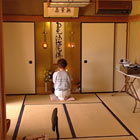
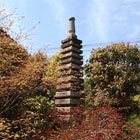
Some parts of this house were quite traditional, with paper walls and floor matting. Other parts were reassuringly familiar, such as the lounge room and the kitchen. Don was impressed with the beautiful garden, with its arrangement of rocks, Japanese maples (Acer palmatum), Japanese cedar (Cryptomeria japonica) and stone pagoda. He speculated that some of the plants would have been grown elsewhere and craned in, which would be expensive but the owners would regard them as living sculptures and well worth the investment.
Town house
This large building has three internal courtyards and it is attached to a kimono factory.
Traditional charm
The purpose of the courtyards is to allow natural light into the long, dark building. The central courtyard is the largest, with smaller ones at the front entrance and at the back. The designs incorporate stones, simple water features and various plants, including azaleas, sasanqua camellias, osmanthus (Osmanthus fragrans), Japanese maples (Acer palmatum) and gold dust plants (Aucuba japonica). All of these plants are readily available and it would be easy to create such a courtyard in Australia. These courtyards are becoming increasingly rare in Japan, and unfortunately may soon disappear altogether.
Kimonos
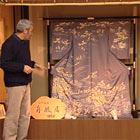
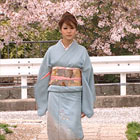
Exquisite kimonos are on display at the factory, priced from A$1,500 to A$30,000. The kimono did not originate in Japan, but in China. The Japanese Imperial court adopted the Chinese-style p’ao during the Nara Period (710-784). Over the centuries the kimono changed and became distinctly Japanese. Different sleeve lengths were worn by married and unmarried women, and the obi, a simple narrow sash, was introduced. The obi gradually became wider and made of embroidered silk. Today the kimono is mostly worn on ceremonial occasions.