You’ll look just like a professional builder if you use these tricks of the trade from Scott Cam.
Use a level
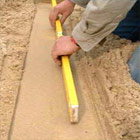
If you have to screed some sand, Scott recommends using a level rather than a piece of timber. That way, you can check to see if your job’s straight and level as you go!
Mark line with finger
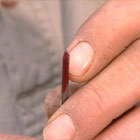
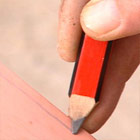
If you need to mark a line on a piece of timber 5mm in from the edge, use your finger as a guide. First, measure and mark a line 5mm in from the edge at one end. Place your finger against the side of the timber, at the same time holding the pencil tip on the 5mm mark. To draw a perfectly straight line, simply slide your hand down the length of the timber.
Use marine grade stainless steel
There are different grades of stainless steel, and some actually rusts after a certain period of time out in the weather. If using stainless steel outdoors, particularly near water, choose marine grade stainless steel and marine grade stainless steel screws. Marine grade stainless steel screws are available at boat shops.
Sand your hammerhead
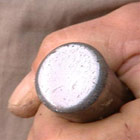
Run sandpaper over your hammerhead in a crisscross motion. This keeps the hammerhead clean and also gives it a rough surface, allowing for better grip with the nail heads.
Blunt your nails
Scott was worried about 3″ nails splitting his timber, so he flattened the nail points out a little with a hammer. A flattened nail tip tends to punch through the timber, rather than spreading the grain of the timber and making it split.
Include your tape measure
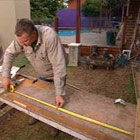
Every tape measure has an increment written on the side; in Scott’s case it was 3″ or 76mm. When measuring between two points the tape housing can be used as an extension of the tape. As an example, Scott butted the housing up against one surface and the end of the tape against the other. The reading on the tape (1270mm) plus the reading on the housing (76mm) gave him the measurement between the two points (1346mm).
Don’t use brass screws
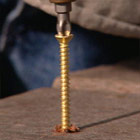
Brass was once very popular for screws, door handles and fittings. However, modern brass is inferior in quality to the brass of yesteryear. If screwing into hardwood, a brass screw could easily snap straight off and you’d be left with the thread inside the hole. Scott is very wary when using brass screws.